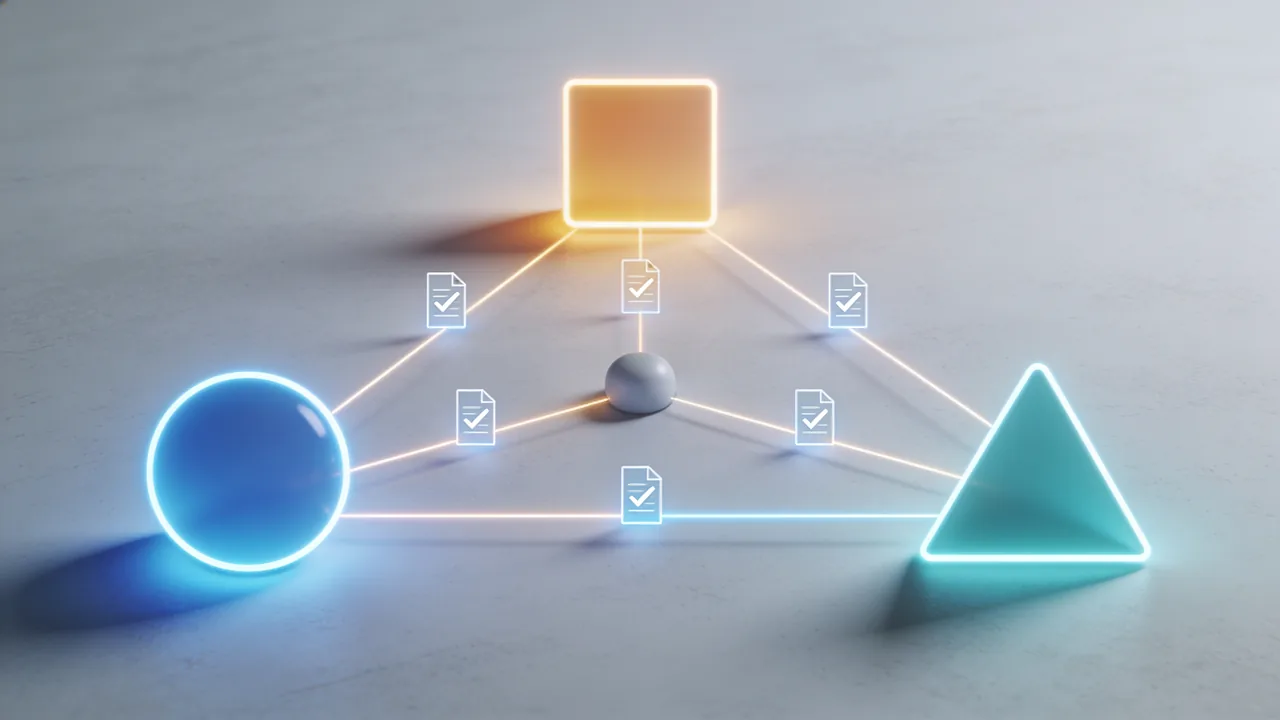
The Next AI Leap: Models That Review Each Other
Single models hit diminishing returns. The next gains come from making top models critique each other: debate, judge, synthesize — with starter code.
Every month brings a new "most capable model." And every month the gap between them shrinks.
The pattern is familiar: four frontier labs leapfrogging each other by a point or two on the same benchmarks, the leaderboard reshuffling every quarter. If you've been refreshing benchmark charts waiting for the model that changes everything, you've probably noticed it isn't coming as a single release anymore.
So here's the thought I keep coming back to as an engineering manager: what if the next leap isn't a smarter brain, but several smart brains that think differently and check each other's work?
That's not a sci-fi pitch. It's a pattern you can build today. Let me explain why it works, then show you the starter code.
Why one model — even a great one — isn't enough
A single model run is a single perspective. It commits to an approach early, and everything after that inherits the same blind spots. Ask it to "double-check," and you mostly get the same reasoning a second time, dressed up with more confidence.
Humans solved this problem a long time ago. We don't ship important decisions on one person's first draft. We do code review. We get a second opinion. We argue in a room until the weak idea falls apart. The output of a team that disagrees well beats the output of any single member.
The interesting part: this transfers to models. When you take two or three capable models that were trained differently — say Claude Opus 5.5 and Claude Fable 5.1, which sit at different points on the capability and cost curve — they make different mistakes. One catches what the other misses. And a third model, acting purely as a judge, can often tell which answer is stronger even when it couldn't have produced the best answer itself.
That last point is the quiet unlock. Verifying a good answer is easier than generating one. It's true for humans grading exams, and it's true for models.
Three patterns worth knowing
You don't need exotic infrastructure for any of these. They're combinations of ordinary API calls.
- Debate / panel. Several models answer the same prompt independently, then each critiques the others' drafts, then someone synthesizes. Best for open-ended reasoning where there's no single right answer to look up.
- LLM-as-judge. One model scores another's work against an explicit rubric. This is your "review each other's work" instinct, formalized — and it's the backbone of most modern eval pipelines.
- Generate → verify. A capable model produces the work; one or more independent models try to refute it. Anything that survives the skeptics ships. This is how you catch the plausible-but-wrong answer that a single model states with total confidence.
Each maps to real machinery you can lean on rather than hand-roll:
- Anthropic's advisor tool lets one Claude consult a different model mid-task for a second opinion or cross-model verification — your panel idea as a first-class primitive.
- Managed Agents support a coordinator that delegates to specialist sub-agents, each with its own model, prompt, and tools, then integrates the results. That's the production-grade version of a team of brains.
But you don't need either to get the idea working. A few messages.create calls will do.
The starter code
Here's a minimal "panel + judge" in Python using the Anthropic SDK. Two different models draft an answer; a third model — acting only as a judge — scores both against a rubric and picks a winner. No frameworks, no beta features.
import anthropic
client = anthropic.Anthropic()  # reads ANTHROPIC_API_KEY from the environment
QUESTION = #a5d6ff">"Should a 5-person startup build its own auth, or use a managed provider? Give a clear recommendation."
# Two drafters that think differently — different models, same prompt.
DRAFTERS = [#a5d6ff">"claude-opus-4-8", "claude-fable-5"]
def draft(model: str, question: str) -> str:
    resp = client.messages.create(
        model=model,
        max_tokens=1024,
        thinking={#a5d6ff">"type": "adaptive"},          # let the model decide how hard to think
        output_config={#a5d6ff">"effort": "high"},
        messages=[{#a5d6ff">"role": "user", "content": question}],
    )
    return #a5d6ff">"".join(b.text for b in resp.content if b.type == "text")
answers = {m: draft(m, QUESTION) for m in DRAFTERS}
# A judge model scores both answers against an explicit rubric.
rubric = #a5d6ff">"\n\n".join(f"--- Answer from {m} ---\n{a}" for m, a in answers.items())
verdict = client.messages.create(
    model=#a5d6ff">"claude-sonnet-4-6",   # a different model as the neutral judge
    max_tokens=1024,
    thinking={#a5d6ff">"type": "adaptive"},
    messages=[{
        #a5d6ff">"role": "user",
        #a5d6ff">"content": (
            #a5d6ff">"You are a neutral judge. Score each answer 1-10 on: correctness, "
            #a5d6ff">"actionability, and honesty about trade-offs. Name a winner and explain "
            f#a5d6ff">"why in three sentences.\n\n{rubric}"
        ),
    }],
)
print(#a5d6ff">"".join(b.text for b in verdict.content if b.type == "text"))
A few deliberate choices worth calling out:
- The judge is a different model from the drafters. A model grading its own work grades generously. Cross-model judging is where the honesty comes from.
- No
temperature. The current top-tier Claude models steer through prompting and effort, not sampling knobs — passingtemperaturenow returns an error rather than helping. Use the rubric to control behavior. - The rubric is explicit. "Which is better?" produces noise. "Score on correctness, actionability, and honesty about trade-offs" produces something you can act on. Vague rubrics are the number-one reason these setups underperform.
Run it and you'll see the judge frequently pick the answer that names its own trade-offs honestly over the one that sounds more authoritative. That's the whole point — you've built a system that rewards being right and humble over being confident.
Where this earns its keep — and where it doesn't
I'm not going to pretend this is free. You're paying for three model calls instead of one, and you're adding latency. That math matters — I wrote a whole piece on how AI spend quietly becomes waste, and bolting a three-model panel onto a request that didn't need it is exactly the kind of waste I meant.
So be honest about the tier:
| Task | Worth a panel? |
|---|---|
| Classifying a support ticket | No — one fast model, done |
| Summarizing a meeting transcript | No — single call |
| A high-stakes architecture recommendation | Yes — disagreement catches blind spots |
| Code review before a risky merge | Yes — generate-then-refute earns its cost |
| Research synthesis across messy sources | Yes — diverse perspectives, then judge |
The bigger picture
We spent the last few years asking "which model is best?" I think that's the wrong question now. The leaderboard is tight and getting tighter, and the answer changes monthly. The more durable question is the one I opened with: how do I build systems that get the best out of several models at once — and let them keep each other honest?
We're not just building smarter individual brains anymore. We're learning to assemble them into something that reasons better than any one of them alone — the same way a good engineering team outperforms its smartest individual member. That feels like the more interesting frontier.
I'm planning to build a small public demo of this for the tools section of this site — a panel you can throw a question at and watch the models argue it out. If you've built something similar, or you think I'm wrong about where the gains are, I genuinely want to hear it.
Building multi-model systems, or just arguing about where AI is headed? Find me on LinkedIn — I read every message.
Related Reading:
Enjoying this article?
Get posts like this in your inbox. No spam, unsubscribe anytime.