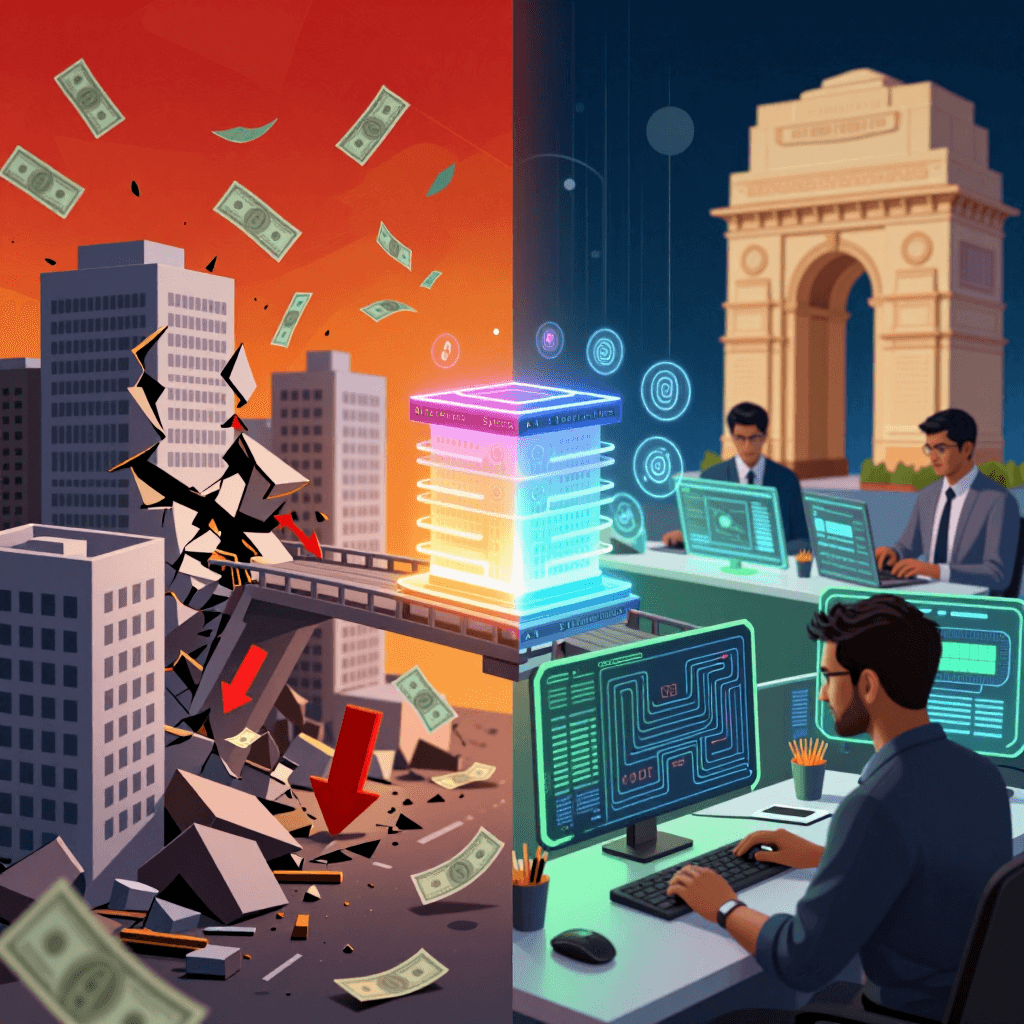
The SaaSpocalypse's Silver Lining for Indian IT
$285 billion vanished from SaaS stocks in a day, and Indian IT firms are poised to seize the chaos. Why this may be India's biggest opening since Y2K.
The SaaSpocalypse's Silver Lining for Indian IT
February 3, 2026. The day the SaaS industry got its scare.
Anthropic quietly updated its Claude Cowork plugin page on January 30, 2026, detailing agentic capabilities that could automate swaths of enterprise workflows. By the time markets opened on February 3, the implications had sunk in, and the selloff was brutal. $285 billion in market value evaporated across software, financial services, and asset management companies. Gartner crashed 21%. Salesforce, Oracle, Adobe, all down 10 to 15%. The JPMorgan US software index fell 7% in a single session.
The ground had already been shaking. The S&P North American Software Index dropped 15% in January 2026 before the February rout, as investors reassessed SaaS valuations against faster AI capabilities.
The tech world coined a new term that day: "SaaSpocalypse."
But while Silicon Valley panicked, something interesting happened in India. TCS, Infosys, and Wipro started quietly positioning themselves for what could be the biggest IT services boom since Y2K.
Here's why the death of SaaS might actually be the rebirth of Indian IT.
The hype vs. the reality
Let me say one thing plainly: AI agents aren't replacing enterprise software anytime soon.
Yes, Claude Cowork can review contracts. It can automate compliance workflows. It scared the hell out of investors. But there's a massive gap between "demos well" and "runs in production at enterprise scale."
The hard limitations no one's talking about
1. Integration hell
46% of enterprises cite integration with existing systems as their #1 barrier to AI adoption. Your fancy AI agent might work great in isolation, but good luck connecting it to:
- That ERP system from 2008
- 47 different internal databases
- Legacy APIs held together with duct tape and prayers
- Compliance systems that require human sign-off
2. Security paralysis
40 to 42% of enterprises won't let AI agents run unsupervised. When you're dealing with financial data, healthcare records, or legal contracts, "the AI made a mistake" isn't an acceptable excuse.
Result? Human-in-the-loop becomes mandatory. That's augmentation, not replacement.
3. The Gartner reality check
Here's the stat that should make Indian IT executives smile: Gartner predicts 40% of AI agent projects will be scrapped by 2027.
Not because the AI doesn't work. Because enterprises can't operationalize it.
They can't integrate it. Can't secure it. Can't audit it. Can't govern it. Can't make it comply with regulations across 47 different countries.
Guess who knows how to do all of that?
What's actually happening in Indian IT
This isn't speculation. The migration wave has already started.
The numbers
In December 2025, TCS, Infosys, Wipro, and Cognizant announced plans to deploy over 200,000 Microsoft Copilot licenses — more than 50,000 each.
But here's what's more interesting:
- TCS: Already generating ₹12,500 crore (about $1.5 billion) in annualized AI revenue
- Sector projection: $2 billion+ in recurring AI services revenue in the next 12 to 18 months
- Hiring surge: 12.5 lakh (1.25 million) new tech jobs coming in AI integration, migration, and governance
These aren't pilot projects. This is full-scale industrial transformation.
What they're actually doing
While the SaaS world burns, Indian IT firms are:
- Integrating AI into legacy systems (because someone has to)
- Building governance frameworks (because enterprises can't trust unsupervised AI)
- Creating hybrid workflows (because pure AI replacement doesn't work)
- Handling change management (because humans still run companies)
Sound familiar? It's the same playbook from:
- Y2K (someone had to fix all that legacy code)
- ERP migrations (SAP implementations that took years)
- Cloud migrations (AWS/Azure transformations)
History doesn't repeat, but it rhymes.
The irony that changes everything
Here's where it gets funny.
Indian IT firms are deploying 200,000 Microsoft Copilot licenses and paying Microsoft billions for "AI transformation."
Meanwhile:
- Microsoft uses Claude (Anthropic) internally for many tasks
- Claude Cowork, the thing that caused the SaaSpocalypse, is an Anthropic product
- Anthropic just threatened the entire SaaS ecosystem that Microsoft and Indian IT firms integrate
So Indian IT is paying Microsoft for AI tools, while Anthropic threatens their clients' business models, and Microsoft themselves uses Claude behind the scenes.
It's chaos. Beautiful, billable chaos.
And when enterprises are confused, overwhelmed, and desperate? They call the integrators.
The most likely scenario (2026 to 2030)
Based on current enterprise adoption patterns, here's what I think happens.
Phase 1: The productivity ceiling (now to 2027)
AI hits a wall at 40 to 60% task automation. That's enough to disrupt SaaS pricing models (fewer seats needed), create panic in software stocks, and generate massive consulting demand.
But it's not enough to eliminate enterprise software entirely.
Phase 2: The migration scramble (2027 to 2028)
Enterprises realize they can't just "replace Salesforce with Claude." They need:
- Integration: Connect AI to existing systems
- Governance: Audit trails, compliance, security
- Hybrid workflows: Some AI, some human, all orchestrated
- Change management: Train 10,000 employees on new processes
This is where Indian IT makes billions.
Phase 3: The augmentation economy (2028+)
The new reality: SaaS + AI + integration glue.
It's not SaaS or AI. It's both, duct-taped together with custom middleware, governance layers, and human oversight.
More complexity means more billable hours. TCS, Infosys, and Wipro are already positioning as "AI-first transformation partners" because they saw this coming.
Why Indian IT wins this round
1. Enterprise lock-in works both ways
Yes, enterprises are locked into Salesforce, SAP, Oracle. But they're also locked into TCS for their ERP system, Infosys for their data centers, Wipro for their IT operations.
AI doesn't change that. If anything, it makes the integration layer more valuable.
2. Scale, experience, cost
Global enterprises have money and urgency, but no internal expertise. Indian IT firms have scale (200,000 engineers each), experience integrating complex systems, and lower costs than Western consulting firms.
It's not a fair fight.
3. The AI-first positioning
Indian IT firms learned from the cloud migration wave. They're not waiting for clients to ask for help. They're proactively deploying AI internally (200k Copilot licenses), building AI-native tools (TCS WisdomNext, Infosys Topaz), creating governance frameworks, and training armies of AI integration specialists.
By the time enterprises panic, Indian IT will already have the playbook ready.
The counter-argument: what if AI actually works?
Fair question. What if Claude (or GPT-5, or whatever comes next) achieves true AGI-level capability?
If AI agents can reliably handle complex multi-step workflows, integrate seamlessly with any system, require minimal human oversight, and self-audit and self-govern — then yes, Indian IT services also gets disrupted.
But current trajectory? That's 5 to 10 years away, minimum. Gartner's "40% of projects scrapped by 2027" suggests we're nowhere close.
And even if AGI arrives, someone still needs to deploy it across 47 different business units, train 10,000 employees, ensure regulatory compliance, and migrate legacy data.
That's still a services business.
The real winners: integration beats innovation
Here's the uncomfortable truth no one wants to say out loud.
In enterprise IT, integration beats innovation.
Doesn't matter if your AI is 10x better. If it doesn't integrate with SAP, Oracle, Salesforce, Microsoft, and 47 custom internal systems, it's worthless.
Indian IT firms spent 40 years becoming integration specialists. They know every legacy system, every compliance requirement, every enterprise workflow.
That knowledge is now more valuable than ever.
While AI startups fight over whose model is better, Indian IT firms are quietly integrating all of them, building abstraction layers, creating governance frameworks, and billing by the hour.
What this means for Indian developers
If you're in Indian IT, here's your playbook.
Skills to double down on
- AI integration (not just prompt engineering)
- Enterprise architecture (systems thinking)
- Governance and compliance (boring but billable)
- Change management (humans over tech)
Skills that matter less
- Pure AI model training (commoditizing fast)
- Generic SaaS development (market crashing)
- Frontend-only work (AI generates 80% of it now)
The money is in the messy middle — connecting AI to reality.
The opportunity for Indian startups
Instead of building yet another SaaS tool, consider:
- AI-native tools for the Indian market (Hindi, regional languages, local workflows)
- Governance platforms (help enterprises manage AI safely)
- Integration middleware (the glue between AI and legacy systems)
Global SaaS is expensive. AI tools could open access for Indian SMBs.
The bottom line
The SaaSpocalypse isn't the end of enterprise software. It's the beginning of a new era: the age of integration.
Success isn't about having the best AI or the best SaaS. It's about making them work together in the real world.
And if there's one thing Indian IT has proven over 40 years, it's this: when technology disrupts the world, someone needs to clean up the mess.
That someone just made $2 billion in annualized revenue helping enterprises "integrate AI at scale."
The SaaSpocalypse might have killed SaaS valuations. But it just handed Indian IT services the biggest opportunity since Y2K.
TL;DR
- SaaSpocalypse: $285B wiped out in SaaS stocks (Feb 2026)
- Reality: AI can't fully replace enterprise software yet
- 40% of AI projects will fail by 2027 (Gartner)
- Indian IT is already capitalizing: $2B+ in AI services revenue
- The irony: Microsoft sells Copilot but uses Claude internally
- The pattern: Y2K to ERP to cloud, now AI migration
- The winner: integration firms (TCS, Infosys, Wipro)
- Timeline: 5 to 10 years of migration work ahead
- For developers: learn integration over pure AI development
The chaos isn't a bug. It's the business model.
Related Reading:
- Indian IT Goes All-In on AI: What It Means for You
- India's IT Industry at a Crossroads with AI
- India's Tech Paradox: Data Superpower or Digital Colony?
What do you think? Is this the next IT services boom, or will AI disrupt faster than expected? Share your thoughts in the comments below or connect with me on LinkedIn.
Enjoying this article?
Get posts like this in your inbox. No spam, unsubscribe anytime.