Krutrim Didn't Fail — It Told an Uncomfortable Truth
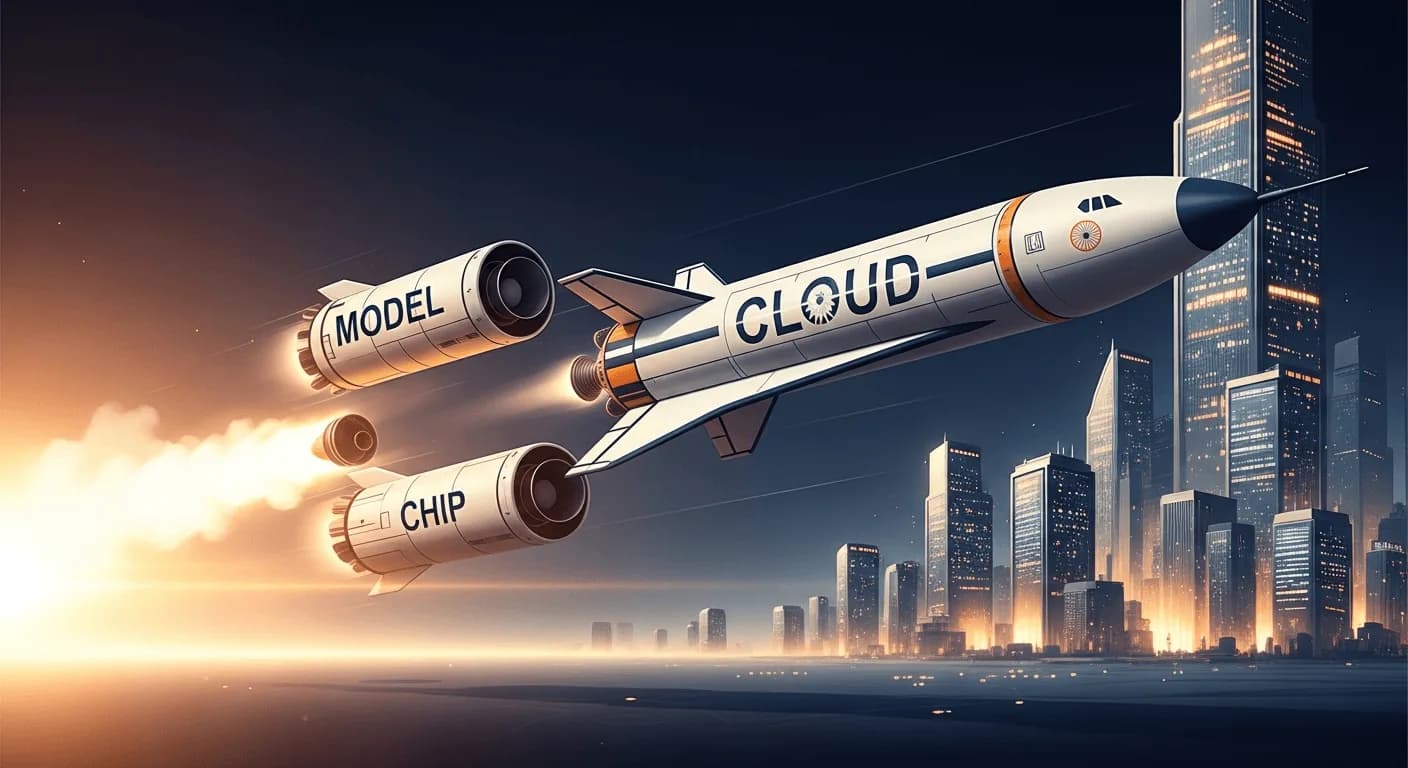
India's first GenAI unicorn quietly paused foundation models and chips to become a cloud company. It looks like defeat — it may be the honest move.
May 5, 2026. TechCrunch put the wider world on notice about something Bhavish Aggarwal had quietly admitted months earlier: Krutrim, India's first GenAI unicorn, had stopped trying to build a frontier foundation model. It had also paused its in-house chip program. The headcount that crossed 550 in August 2025 was down to roughly 150 by March 2026 — a 70% cut in seven months.
The Indian tech press called it a crisis. Outlook Business ran a piece arguing that Bhavish's speed was breaking the country's only AI unicorn. The framing was clean: the man who promised India a homegrown LLM and a homegrown chip had abandoned both.
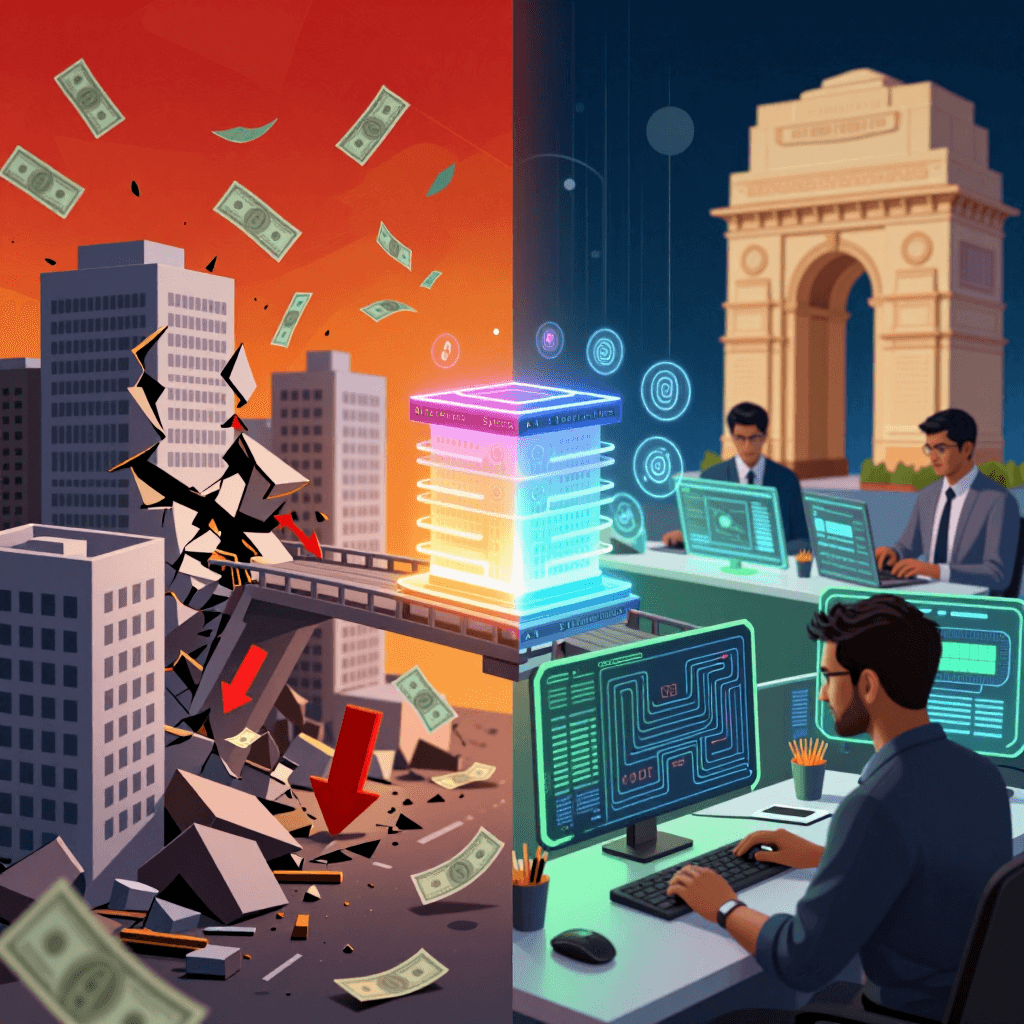
I want to argue the opposite. Krutrim didn't fail. It told the truth that no other Indian AI startup will say out loud — that building frontier foundation models from India is currently uneconomic, that the silicon dream is decades away, and that the smart play is to become India's sovereign cloud layer instead.
Whether that truth is a victory or a surrender is the actual question. The "crisis" narrative misses it entirely.
What actually happened
The facts, stripped of spin.
In late 2025, Krutrim paused two things at once: foundation LLM training and chip design. Capital and talent were reallocated to AI cloud — GPU capacity, inference, model hosting, enterprise tooling. The pitch shifted from "India's OpenAI" to "India's sovereign AI cloud."
FY26 numbers don't read like a company in collapse: revenue around Rs 300 crore (~$36M), roughly 3x YoY, first annual net profit since founding, PAT margin over 10%, 25+ large enterprise customers across telcos, BFSI, consumer internet, healthcare, logistics. Company says it's financially self-sustaining with no immediate need for external funding.
The headcount cut was brutal — 550+ down to 150-160 — but it tracks the strategy. Foundation model research and chip design are talent-heavy in ways cloud services aren't. Stop building the models, stop needing the researchers.
In May 2025, Bhavish posted on X: "As committed, Azure spend is now 0. All workloads on Krutrim Cloud." Ola Group had moved off Microsoft Azure entirely. The unicorn now had an anchor customer that happened to share a founder. That last detail is where the story gets interesting.
Is it product-market fit, or is it Ola subsidizing itself?
This is the skeptic's case, and it deserves to be taken seriously.
A 3x revenue jump in a year is extraordinary. A first-ever profit on top of it is rarer still. But how much of that Rs 300 crore is genuine third-party demand, and how much is one founder moving his own group's workloads from one bucket (Azure) into another bucket he also owns (Krutrim)?
We don't have the split. The company hasn't disclosed it, and by some accounts a meaningful share of FY26 revenue is intra-group. That's a real caveat. Profitability achieved by billing your sister company at favorable rates is not the same as profitability achieved by winning competitive RFPs against AWS.
But — and this is important — the same critique was leveled at AWS in 2006. Amazon spent years building infrastructure for itself, then sold the excess capacity. The "internal infra → external product" pipeline is one of the most reliable patterns in cloud history. Alibaba Cloud started the same way. So did Google Cloud, in a different shape.
The Reliance Jio playbook is closer to home. Jio's first user was Reliance itself — every employee, every group company, every retail outlet. The anchor tenancy gave it scale economics no competitor could match. Then it opened the network and rewrote telecom pricing in eighteen months.
If Krutrim Cloud is following that script — Ola as the captive anchor, then external enterprises layered on top — the 25+ regulated customers in telcos and BFSI are the signal that matters more than the revenue split. Those industries don't sign with you because your founder's other company is a customer. They sign because the price-performance works.
Honest read: the profitability story has an asterisk, but the customer mix suggests the asterisk is shrinking. Watch FY27. If external revenue grows faster than internal, this was a pivot. If not, it was a refinancing.
The chip pause is the bigger story than the model pause
The model pivot is rational, and frankly overdue across Indian AI.
By mid-2026, Kimi K2.6, DeepSeek V4, and Gemma 4 give you near-frontier capability at roughly one-third the inference cost of US-hosted closed models — and they ship with weights you can run on your own GPUs. I've written before about how open-source AI hit 89% enterprise adoption and reshaped the build-vs-buy math for everyone outside the US. Why burn $200 million of Indian capital training a model that will be obsolete in eight months when you can fine-tune an open model for a tenth of the cost?
Spending that money on foundation model training in 2026 isn't ambition. It's vanity.
The chip pause is different. That one stings.
A homegrown AI chip wasn't going to compete with NVIDIA in 2027. Nobody believed that. But chip design is a generational discipline — you don't build it in a year, you accumulate it over decades. Pausing the program means losing the team. Losing the team means losing the institutional memory. And in silicon, institutional memory is the entire moat.
This connects directly to the data-colony argument I've made before about India producing 20% of the world's data and holding 3% of the compute. The three camps — Superpowers, Buyers, Data Colonies — sort countries by how much of the AI stack they actually control. Foundation models are one layer. Cloud is another. Chips are the floor under both.
When Krutrim paused chip design, India quietly conceded the silicon layer. There are other efforts — Tata, Vedanta on the fab side, some startups on design — but Krutrim was the one with both founder ambition and unicorn-scale capital pointed at AI silicon specifically. Without it, the country has data-center buildouts (significant — the $50 billion India DC boom is real) but no domestic chip story to put inside them.
The chips will keep being NVIDIA's. The data centers will be Indian-owned and Indian-located, but the value capture inside them will continue flowing to American silicon vendors and their Taiwanese fabs. That's the silent concession nobody's writing about.
National AI champion to national cloud reseller
Here's the framing that actually maps Krutrim onto the global picture.
The three-camps model sorts countries into Superpowers (US, China — own the full stack), Buyers (UAE, Saudi Arabia — write cheques for sovereignty), and Data Colonies (India, Brazil, Indonesia — generate the data, rent the infrastructure).
When Krutrim launched in 2024, the implicit pitch was Camp 3 to Camp 1. Indian models, Indian chips, Indian cloud, end to end.
The 2026 pivot is a quieter pitch: Camp 3 to Camp 2. Buy the models (open-source from China and Google), buy the chips (NVIDIA, while the export window stays open), but own the cloud layer — the customer relationship, the data residency, the regulatory surface.
That's not nothing. It's how the UAE and Saudi Arabia are buying their way out of dependency. India can't write $100 billion sovereign-wealth cheques, but it can build a domestic cloud champion good enough to keep Indian enterprise workloads inside Indian jurisdiction.
Is that progress or surrender? Both, depending on the time horizon. Short term, it's progress — every workload that moves from AWS to Krutrim is one less data flow into US jurisdiction. Long term, it's surrender on the layers that matter most: the models that shape how a billion Indians interact with AI, and the silicon that sets the cost curve. You can buy your way to sovereignty at the cloud layer. You can't buy your way there at the model and chip layers. Those have to be built. And nobody in India is building them at unicorn scale right now.
What the customer list tells us
The 25+ enterprise customers across telcos, BFSI, consumer internet, healthcare, and logistics is the most underrated detail in the story.
These aren't startups choosing Krutrim because it's cheap. These are regulated, procurement-heavy industries that take eighteen months to onboard a cloud vendor. If they're signing in 2026, conversations started in 2024 — before the pivot, before the layoffs.
Two things drive that signing. First, data residency anxiety is real — DPDP enforcement firming up, RBI and IRDAI pushing localization, CIOs nervous about hard dependency on US hyperscalers. An Indian-owned, Indian-jurisdictioned cloud is a feature, not a marketing slogan. Second, the AI integration wave needs somewhere to run that isn't the same US clouds hosting American competitors.
Krutrim is positioned at the intersection of those two trends. That's not luck. That's the pivot working.
The crisis narrative is wrong, but not for the reason you think
When Outlook Business framed this as Bhavish's speed breaking India's only AI unicorn, the implicit assumption was that the original strategy — frontier model, in-house chip, full stack — was the strategy India needed. The pivot is therefore a failure.
I think that gets it exactly backwards.
The original strategy was the failure. It was a strategy designed for a 2023 world where US closed models were the only frontier game in town, where compute costs were going up and to the right, and where Indian capital had to be deployed at the model layer or risk irrelevance. By the time 2025 ended, every one of those premises had collapsed. Chinese open-source went from punchline to frontier-adjacent. Inference costs collapsed. The model layer commoditized faster than anyone predicted.
In that world, continuing to burn capital training a Krutrim foundation model would have been the failure. The pivot is the company adapting to reality faster than the narrative could.
The real crisis isn't that Krutrim pivoted. It's that India has exactly one GenAI unicorn, and the moment it makes a rational strategic adjustment, the entire conversation flips to whether the country's AI ambitions are over.
If you have one of something, every decision it makes becomes existential. That's a portfolio problem, not a Krutrim problem.
What this means for Indian deep-tech
For founders: the Krutrim pivot is permission. Permission to stop pretending you're going to out-train OpenAI from Bangalore. Pick a layer of the stack where India can actually win — cloud, integration, vertical AI — and pour everything into it. The "full stack national champion" pitch is dead. It was never going to work at this round size.
For investors: unit economics finally matter again. Indian AI valuations in 2024-25 were priced on full-stack ambition. 2026 valuations will get priced on revenue and gross margin. A smaller market, but a healthier one.
For policy: if Krutrim is the template — pause the model layer, pause silicon, win the cloud layer — then India AI Mission funding needs to follow the survivors, not the slide decks. Money for foundation model training in 2026 is money lit on fire. Money for sovereign cloud and the integration economy compounds.
Prediction: by FY28, Krutrim Cloud's external (non-Ola) revenue will exceed its internal revenue, and the company will look more like a domestic AWS competitor than an OpenAI competitor. The bear case — Ola stalls, the anchor weakens, external pull never materializes — is live. But both outcomes assume the original full-stack vision is quietly dead. It is.
Takeaway
- Krutrim's pivot isn't a failure — it's the most honest strategic call in Indian AI right now.
- Pausing foundation models in 2026 is rational. Pausing chip design is the bigger long-term concession, and nobody's discussing it.
- Profitability has an asterisk (Ola is the anchor customer), but the AWS and Jio precedents say that's how cloud businesses are supposed to start.
- The real crisis isn't Krutrim — it's that India has one AI unicorn and treats every decision it makes as a referendum on national capability.
- Watch FY27. If external revenue outgrows internal, this was a pivot to a sovereign cloud play. If it doesn't, it was a refinancing. Either way, the model and chip dreams are paused for the decade.
Related Reading:
Enjoying this article?
Get posts like this in your inbox. No spam, unsubscribe anytime.