VLJA: Meta's AI That Thinks in Meaning, Not Words
How Meta's Vision-Language Joint Embedding Architecture (VLJA) challenges modern AI by predicting meaning instead of tokens — a possible post-LLM era.
VLJA: Meta's AI That Thinks in Meaning, Not Words
What if AI didn't need to predict words to be intelligent?
This isn't a philosophical thought experiment—it's the central question behind Meta's groundbreaking research that's challenging the very foundation of modern artificial intelligence. With legendary AI researcher Yann LeCun at the helm, Meta's team has unveiled VLJA (Vision-Language Joint Embedding Architecture), a system that abandons the token-by-token text generation paradigm that has dominated AI for years.
The results are remarkable: faster training, fewer parameters, real-time inference, and in some cases, performance that beats frontier models like GPT-5, Claude Opus 4.7, and Gemini 3 on specific physical-understanding tasks.
Welcome to what might be the beginning of the post-LLM era.
The Problem with Current Vision-Language Models
Before we dive into VLJA's innovations, we need to understand why the current approach is fundamentally flawed.
The Dirty Secret of Vision-Language AI
Most Vision-Language Models (VLMs) today are essentially text generators that happen to see images. They process visual input, sure, but their core intelligence mechanism is predicting the next word in a sequence. This creates several critical problems.
Problem #1: Semantic Redundancy
Consider these three phrases:
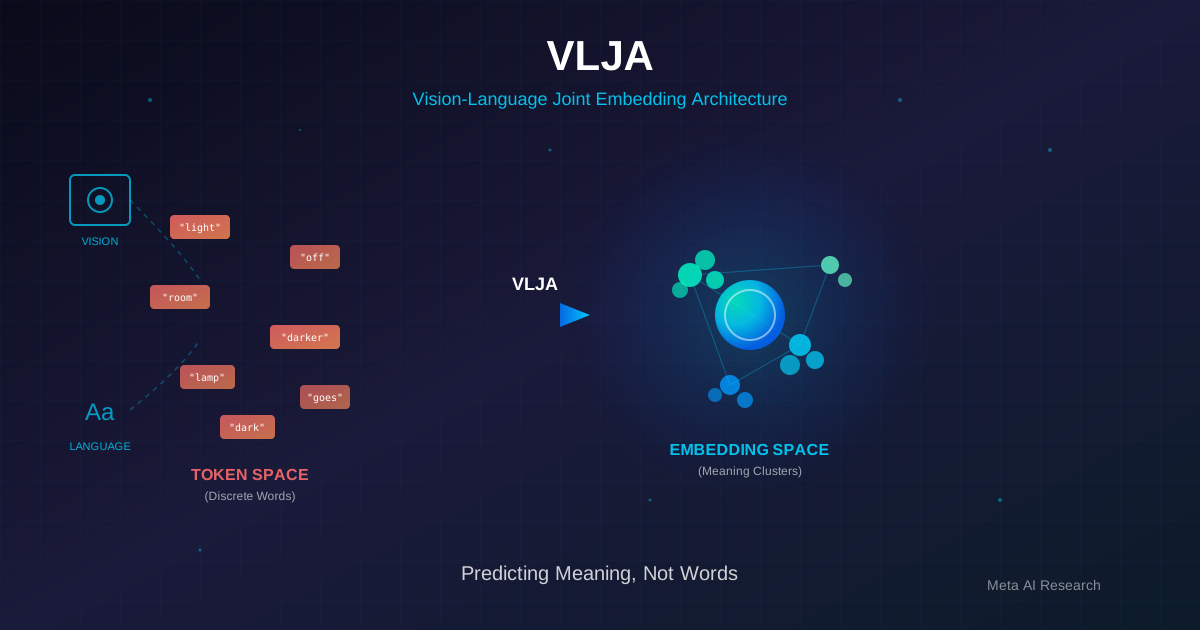
- "The light turns off"
- "The room gets darker"
- "The lamp goes dark"
To a human, these convey nearly identical meaning. But to a token-based model, they are completely different sequences. The model must learn each variation independently, wasting enormous computational resources on what amounts to stylistic preferences.
This isn't a minor inefficiency—it's a fundamental architectural flaw. Models spend most of their training effort learning the surface patterns of language rather than actual understanding.
Problem #2: Real-Time Is Impossible
Token-by-token generation creates inherent latency. The model must output words sequentially, and the meaning only emerges after the generation completes.
Where does this fail catastrophically?
- Robotics: A robot can't wait for a full sentence to understand "obstacle ahead"
- AR glasses: Real-time visual interpretation requires instant understanding
- Autonomous vehicles: Split-second decisions demand immediate comprehension
- Live video analysis: Streaming understanding, not post-hoc narration
The Hidden Cost
Here's the uncomfortable truth: most training effort in current VLMs goes toward modeling how humans phrase things, not what they're actually saying.
It's like hiring a translator who spends 80% of their time perfecting their accent and only 20% understanding the content.
What Makes VLJA Different
The Core Innovation
VLJA's breakthrough is deceptively simple to state but profound in its implications:
VLJA predicts embeddings (meaning) instead of tokens (words).
In traditional models, language is the mechanism of intelligence. In VLJA, words become an optional output, not the mechanism of intelligence itself.
Understanding Embeddings
If you're not familiar with embeddings, think of them as continuous mathematical representations of meaning. Instead of discrete symbols (like words), embeddings exist in a high-dimensional space where similar concepts are close together.
Here's the key insight: In embedding space, the phrases "the light turns off" and "the room gets darker" naturally cluster together because they mean similar things. In token space, they're completely different sequences with no inherent relationship.
By operating in embedding space, VLJA transforms a messy multimodal problem (vision + language) into a cleaner single-mode learning problem (just meaning).
Architecture Deep Dive
VLJA consists of four main components, each with a distinct role. Let's break them down.
1. Visual Encoder (The Eyes)
Purpose: Processes images and video frames into visual embeddings
Technical Details:
- Uses VJEPA 2 with 304M parameters
- Stays frozen during training
- Converts raw pixels into semantic representations
Think of this as the system's visual cortex—it sees the world and creates a mathematical representation of what it observes.
2. Predictor (The Brain)
Purpose: Takes visual embeddings + text queries → predicts answer embeddings
Technical Details:
- Built on Llama 3.2 1B transformer architecture
- No causal masking (vision and text interact freely)
- This is where actual "understanding" occurs
This is where the magic happens. The predictor doesn't generate words—it predicts what the meaning of the answer should be. It's the core reasoning engine of the system.
3. Y Encoder (The Teacher)
Purpose: Converts target answers into embeddings during training
Technical Details:
- Creates the learning target
- Captures meaning, not exact wording
- Critical for building a structured semantic space
The Y Encoder teaches the system what "correct meaning" looks like. It doesn't care about exact phrasing—it creates target embeddings that capture semantic content.
4. Y Decoder (The Translator)
Purpose: Converts embeddings back to human-readable text when needed
The Plot Twist: This component is barely used.
- Only activated when text output is explicitly required
- Not involved in training at all
- Most operations stay entirely in embedding space
This is perhaps the most radical aspect of VLJA: the text decoder is practically an afterthought. The system thinks in meaning and only translates to words when absolutely necessary.
How Training Works
VLJA's training process is elegantly different from traditional approaches.
The Training Loop
- Visual input passes through the frozen Visual Encoder
- Text query is processed alongside visual embeddings by the Predictor
- Predictor outputs a predicted answer embedding
- Y Encoder converts the ground truth answer into an embedding
- Loss is computed: pull predicted meaning toward correct meaning
Contrastive Learning
The loss function does two things:
- Attracts similar meanings (correct answers cluster together)
- Repels different meanings (incorrect answers stay apart)
This prevents "collapse" (where all embeddings become identical) and creates a well-organized semantic space.
The Efficiency Breakthrough
Notice what's missing: no heavy language decoder during training.
The model learns to organize meaning directly, without the computational overhead of generating token sequences. This is why VLJA trains so much faster than traditional VLMs.
Performance Benchmarks: The Numbers Don't Lie
Training Efficiency
Meta ran a controlled head-to-head comparison:
- Same vision encoder
- Same data
- Same batch size
- Same training steps
The only difference: VLJA's embedding approach vs. traditional token-based generation.
Results at 5 million training samples:
| Metric | VLJA | Token-Based Baseline |
|---|---|---|
| CIDEr Score | 14.7 | 7.1 |
| Classification (Top-5) | 35% | 27% |
| Parameters Used | ~500M | 1B |
Inference Efficiency: Selective Decoding
Here's where VLJA really shines for real-world applications.
Traditional models must decode every frame of a video. VLJA introduces selective decoding: only generate text when the meaning actually changes.
Test case: EgoXO4D videos (6-minute procedural videos)
Result: 2.85x reduction in decoding operations with similar performance.
For edge devices, wearables, and robotics, this is transformational. Less computation means longer battery life, lower costs, and faster response times.
Versatility: One Model, Many Tasks
VLJA handles multiple tasks without task-specific modifications:
- ✅ Text generation
- ✅ Image/video classification
- ✅ Text-to-video retrieval
- ✅ Discriminative VQA
- ✅ Visual reasoning
Traditional approaches need separate model heads for each task. VLJA uses the same architecture for everything.
Specific Benchmark Results
Video Classification (8 datasets):
- Outperforms CLIP and SigLIP-2
Text-to-Video Retrieval (8 datasets):
- Competitive with models trained on 86 billion samples
- VLJA only used 2 billion samples (43x less data)
VQA Performance:
- Strong results on GQA, TallyQA, POPE benchmarks
- Competitive with InstructBLIP and QwenVL despite fundamentally different architecture
The Killer Result: World Modeling
This is where VLJA's approach shows its true potential.
Physical causality tasks: Understanding cause-and-effect in the physical world
| Model | Accuracy |
|---|---|
| GPT-4 (original benchmark baseline) | ~60% |
| Claude 3.5 Sonnet (baseline) | ~62% |
| Gemini 2.0 (baseline) | ~63% |
| VLJA | 65.7% |
At the time of publication, a model with 500M active parameters beat then-frontier trillion-parameter models on understanding physical reality.
Why? Because directly predicting meaning is fundamentally better than narrating the world in words for certain tasks.
Technical Deep Dive: Ablation Studies
Meta's ablation studies reveal what makes VLJA tick:
Critical Components
| Component Removed | Impact |
|---|---|
| Caption-based pre-training | Severe performance drop |
| Frozen Y Encoder | Alignment significantly hurt |
| Smaller predictor | VQA performance degradation |
Key Findings
- Caption pre-training is critical: The model needs language grounding before learning joint embeddings
- Y Encoder must be trainable: Freezing it prevents proper alignment
- Larger predictors help VQA: More reasoning capacity improves question-answering
- Visually-aligned text encoders boost retrieval: Better visual-text alignment improves search tasks
Y Encoder vs. CLIP/SigLIP
On hard negative benchmarks (SugarCrepe++, VizWiz), VLJA's Y Encoder outperforms industry-standard encoders like CLIP and SigLIP. The joint training process creates more discriminative representations.
Real-World Applications
Where VLJA Excels
Smart Glasses & AR Devices
Continuous visual understanding with minimal latency. Imagine glasses that understand what you're looking at in real-time, not after a 2-second delay.
Robotics
Real-time environmental understanding without the computational overhead of text generation. Robots can react to visual input instantly.
Autonomous Vehicles
Split-second scene interpretation. When a child runs into the street, you don't have time for token-by-token generation.
Live Video Analysis
Streaming comprehension instead of post-hoc summarization. Security systems, sports analysis, and broadcast monitoring benefit enormously.
Wearable AI Assistants
Lower power consumption means all-day battery life. Edge deployment becomes practical.
Medical Imaging
Fast, accurate interpretation of scans and images where speed can save lives.
Where Traditional LLMs Still Win
VLJA isn't meant to replace LLMs for everything:
- Deep reasoning chains: Multi-step logical deduction
- Complex tool use: Coordinating multiple external systems
- Agent-style planning: Long-horizon task decomposition
- Long-form creative writing: Extended narrative generation
- Explicit reasoning steps: When you need to show your work
For tasks requiring extended linguistic reasoning, traditional LLMs remain superior. VLJA excels at understanding, not necessarily explaining.
Broader Implications
For AI Development
VLJA challenges a fundamental assumption: that intelligence must flow through language.
This research suggests:
- Semantic space may be more fundamental than token space
- Understanding can exist independent of linguistic form
- New research directions in multimodal learning are now open
- Future AI systems might operate primarily in embedding space
For the Industry
Cost Reduction
- Fewer parameters = lower computational costs
- Less inference compute = cheaper deployment
- Lower energy consumption = reduced environmental impact
New Possibilities
- Real-time applications become practical
- Edge computing becomes viable
- AI becomes more accessible to smaller companies
Philosophical Questions
VLJA raises profound questions about the nature of intelligence:
- Does intelligence require language? Or is language just one possible interface to underlying understanding?
- Are we anthropomorphizing AI? By forcing models to "think" in words, are we imposing human limitations on systems that could operate differently?
- Is meaning primary? VLJA suggests that semantic understanding might be more fundamental than linguistic expression.
The implications extend beyond engineering into cognitive science and philosophy of mind.
Limitations and Caveats
Let's be clear about what VLJA isn't:
Current Limitations
- Not a replacement for all LLM tasks: Deep reasoning still needs traditional approaches
- Requires text decoder for human interaction: We still need to read the output
- Relatively new: Needs more extensive real-world testing
- Language-specific tasks: May struggle with nuanced linguistic requirements
- Data requirements: Still needs large training datasets
- Scalability questions: Long-term scaling behavior unknown
Research Maturity
This is cutting-edge research, not a production-ready system. Expect iterations, improvements, and possibly fundamental changes as the approach matures.
Future Directions
Potential Developments
Hybrid Systems
VLJA for fast visual understanding + LLM for deep reasoning. The best of both worlds.
Scale Exploration
What happens with larger models? Does the efficiency advantage persist or increase?
Multimodal Expansion
Audio, touch, sensor data, proprioception. Can the embedding approach generalize?
Few-Shot Learning
Can VLJA learn new concepts from minimal examples?
Continual Learning
Can the system adapt without catastrophic forgetting?
Edge Optimization
Further optimizations for mobile, IoT, and wearable deployment.
Conclusion: The Dawn of Post-LLM AI?
VLJA represents more than an incremental improvement—it's a paradigm shift.
The core insight is profound: predicting meaning directly is more efficient and often more effective than predicting words. By operating in semantic space rather than token space, VLJA achieves remarkable results with a fraction of the computational cost.
This doesn't mean LLMs are obsolete. For tasks requiring explicit reasoning, extended generation, or complex linguistic manipulation, traditional approaches remain powerful. But for visual understanding, real-time inference, and efficient deployment, VLJA points toward a different future.
We may be witnessing the emergence of post-LLM architectures—systems that understand the world without being forced to narrate it.
The future of AI might not speak in words—it might just understand.
Key Takeaways
- VLJA predicts meaning (embeddings) instead of words (tokens)
- This eliminates semantic redundancy and reduces computational waste
- Real-time inference becomes practical through selective decoding
- Performance beats larger models on physical understanding tasks
- The text decoder is almost optional—most intelligence operates in embedding space
- This could represent the beginning of post-LLM AI architectures
Further Reading
- Meta AI Research publications on VLJA
- Yann LeCun's papers on self-supervised learning
- VJEPA (Video Joint Embedding Predictive Architecture) documentation
- Contrastive learning literature for understanding the training approach
What do you think about VLJA's approach? Is predicting meaning superior to predicting words? Share your thoughts in the comments below.
Related Reading:
Enjoying this article?
Get posts like this in your inbox. No spam, unsubscribe anytime.