Meta vs OpenAI: Who's Actually Winning the AI Race?
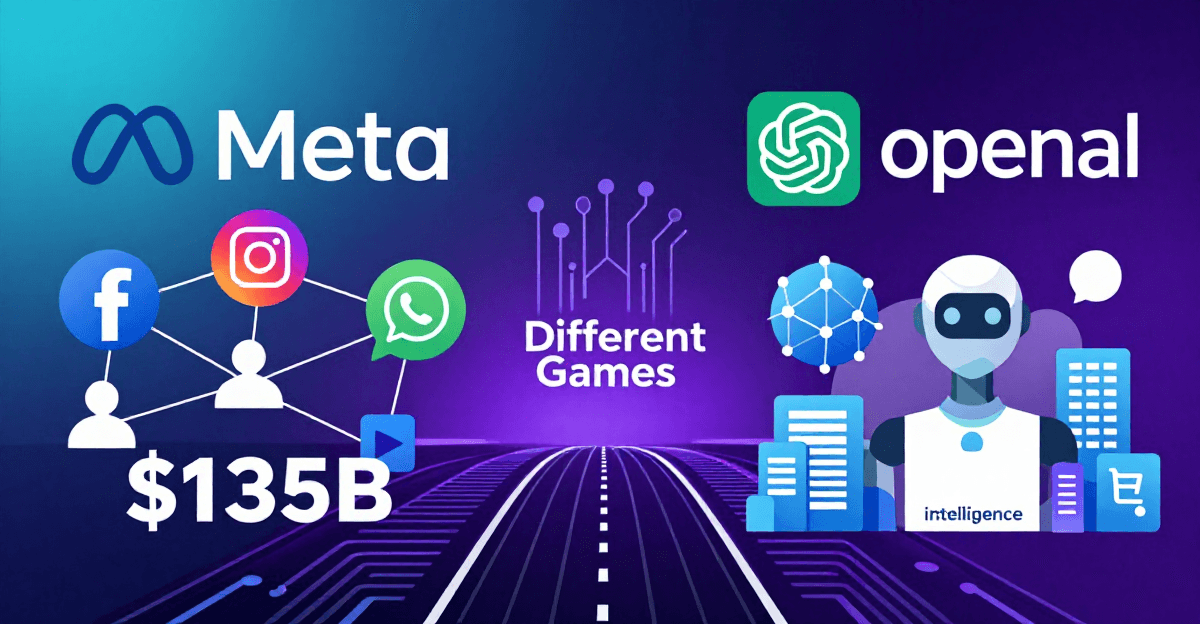
Llama 4 flopped. Is Meta done? Or playing a different game entirely? A deep dive into Meta's $135B bet on 'personal superintelligence' vs OpenAI's model dominance.
When Meta released Llama 4 on April 5, 2025, the reception was... underwhelming.
"Rushed release on a Saturday"
"Underperformed the hype"
"Lost the narrative to DeepSeek"
Meanwhile, OpenAI's GPT-4o and ChatGPT continue dominating headlines. Anthropic's Claude is the new developer darling. Google's Gemini is everywhere.
So is Meta losing the AI race?
Not quite. They're just playing a different game.
The Llama 4 Reality Check
Let me be blunt: Llama 4 wasn't the game-changer Meta hyped it to be.
What Meta promised:
- Revolutionary open-weight models
- 10M token context
- Beat GPT-4o across benchmarks
What we got:
- Three MoE models: Scout (17B), Maverick (17B), Behemoth (2T, announced but not yet released)
- Scout has 10M token context, Maverick has 1M — not the universal 10M that was hyped
- Mixed reviews: "chatty," "off-putting," underperformed expectations
- EU blocked due to regulations
Reception:
- Strong but not dominant
- Quick community adoption on Hugging Face
- API pricing competitive ($0.17/M tokens)
- But criticism: "Meta panicked to compete with DeepSeek"
Status: A solid open-weight model. Not a revolution.
But Here's What Everyone Missed
While tech Twitter was dunking on Llama 4's shortcomings, Meta was making a $115-135 billion bet on something entirely different.
Meta isn't trying to build the best AI model.
They're trying to build the best personalized AI using data no one else has.
The Real Game: Data Moats
Let's compare what each player actually has:
OpenAI's Moat
- Best models (GPT-4, o1, o3)
- Billions in funding (Microsoft-backed)
- ChatGPT brand (everyone knows it)
Their game: Build the smartest AI brain possible
Google's Moat
- Search intent data (what people want to know)
- YouTube (behavior, preferences)
- Android (device data)
- Google Cloud (enterprise reach)
Their game: AI integrated everywhere you already are
Meta's Moat
- 3.2 billion daily users (Facebook, Instagram, WhatsApp)
- Social graph (who you know, what they like)
- Behavioral data (what you share, react to, message)
- Relationship context (your actual social connections)
Their game: AI that knows you through your social life
Why Meta's Strategy is Brilliant (Even if Llama 4 Flopped)
Meta doesn't need the smartest model. They need a model that knows you better than anyone else.
Example: AI Shopping Assistant
OpenAI's approach:
- "Show me running shoes"
- AI searches the web, shows popular options
Google's approach:
- Uses your search history
- "You searched for marathon training last month"
Meta's approach:
- "Your friend Sarah just bought these Nike shoes and loved them"
- "3 people in your running group recommend this brand"
- "Your wife commented 'nice' on someone's Hoka post"
Which one converts to a sale?
That's why Meta is betting $115-135 billion on "agentic commerce" for 2026.
Meta's 2025-2026 Roadmap (The Real Story)
2025: Build the Foundation
- Infrastructure investment ($72B capex)
- Model development (Llama 4, Behemoth)
- Lab restructuring (Meta Superintelligence Labs)
2026: Product Rollouts
- Agentic commerce - AI shopping assistants across FB/Insta/WhatsApp
- AI-generated ads - End-to-end (images, video, targeting) automated
- Personal superintelligence - AI personalized to your social context
- Lattice ad platform - Full automation across all Meta properties
The bet: Social data > Model quality
What "Personal Superintelligence" Really Means
Meta isn't building AGI. They're building something else:
Traditional AI:
- Generic knowledge
- Same for everyone
- Answers based on training data
Meta's "Personal Superintelligence":
- Personalized to YOUR social graph
- Different for every user
- Answers based on your friends, likes, messages, behavior
Example scenarios:
You: "Should I go to this restaurant?"
Generic AI: "It has 4.5 stars on Google"
Meta AI: "Your friend John went last week and loved it. Your wife saved their brunch menu. 2 people in your foodie group recommended it."
You: "What gift should I get my mom?"
Generic AI: "Popular gifts for mothers include..."
Meta AI: "She liked 3 gardening posts this month. She commented 'beautiful' on succulent arrangements. Your sister bought her a plant last year."
Which is more useful?
The $135 Billion Question
Is this strategy worth the insane spending?
Meta's revenue: +22% in 2025
They can afford it. And here's why it might work:
1. Ad Revenue Protection
- Automated AI ads = better targeting = higher ROI
- Personalized commerce = more conversions
- Keeps advertisers locked into Meta ecosystem
2. Social Graph Moat
- No one else has your friend connections
- Google has search, Meta has relationships
- Relationships drive purchase decisions more than search
3. WhatsApp Commerce
- 2 billion users
- Already used for business in India, Brazil, SE Asia
- Add AI commerce agents = massive market
4. Regulatory Advantage
- Open-weight Llama = less scrutiny than closed models
- "We're just enabling developers" defense
- EU blocked Llama 4, but model isn't the main play anyway
The Weakness in Meta's Plan
It's not all roses. Here are the risks:
1. Privacy Backlash
- "AI knows too much about me" creepiness factor
- Regulatory crackdowns (EU already blocking)
- User trust issues (Cambridge Analytica memories)
2. No Frontier Model Lead
- If model quality matters more than data, they lose
- Can't compete with OpenAI o3 or Google's reasoning models
- Llama 4 proved they're not frontier leaders
3. Expensive Bet
- $135B is a LOT
- If agentic commerce flops, shareholders riot
- 2026 must deliver results
4. Competition Copies
- Amazon has shopping data
- TikTok has behavior data
- They can build similar personalized AI
Who's Actually Winning?
Here's the honest answer:
Best AI model: OpenAI (GPT-4, o3)
Best AI scientist hype: Google DeepMind
Best open-weight model: Debatable (Llama vs others)
Best AI integration: Google (everywhere already)
Best AI for commerce: Meta (social graph advantage)
The real answer: They're playing different games.
- OpenAI = Build the smartest brain
- Google = AI everywhere you already are
- Meta = AI that knows your social life
- Anthropic = AI you can trust (safety focus)
- xAI = Wild card (Grok + Twitter data)
There's no single winner. Each is optimizing for different outcomes.
What This Means for You
As a User:
- OpenAI/ChatGPT - Best for knowledge work, coding, research
- Google Gemini - Best for productivity (Gmail, Docs, Search)
- Meta AI - Best for shopping, social recommendations (coming 2026)
- Claude (Anthropic) - Best for sensitive tasks, trustworthy responses
As an Investor:
- Meta's bet is high-risk, high-reward
- If agentic commerce works → stock soars
- If it flops → $135B wasted
- Track 2026 Q1-Q2 product launches closely
As a Developer:
- Don't sleep on Llama despite mixed reviews
- Open-weight = no API costs
- Fine-tuning = customize for your use case
- Behemoth (2T model) was announced but has not been released — it could still surprise if and when it ships
Bottom Line
Llama 4 flopped? Sort of. It was underwhelming.
Is Meta losing the AI race? No. They're just not racing OpenAI.
What's their play? Social data moat + agentic commerce + personalized AI
Will it work? Check back in 2026 Q3.
The smart take: Meta doesn't need the best model. They need a good-enough model + unbeatable data. And they might just have it.
The 2026 Test
If by end of 2026:
- You're shopping via AI assistants on Instagram ✅
- Ads are hyper-personalized and you actually click them ✅
- Meta AI knows your social context better than you do ✅
Then Meta won their game.
If by end of 2026:
- Agentic commerce is a ghost town ❌
- Privacy concerns killed adoption ❌
- Model quality mattered more than data ❌
Then they lost $135 billion.
Place your bets. 🎲
Key Takeaways
✅ Meta isn't competing on model quality - they're competing on personalization
✅ Social graph = their moat - no one else has your friend data
✅ $135B bet on agentic commerce launching 2026
✅ Llama 4 underwhelmed but the real strategy is elsewhere
✅ Different players, different games - no single AI race winner
Which AI do YOU use most? OpenAI, Google, or waiting for Meta's commerce play? Share in the comments below.
Enjoying this article?
Get posts like this in your inbox. No spam, unsubscribe anytime.