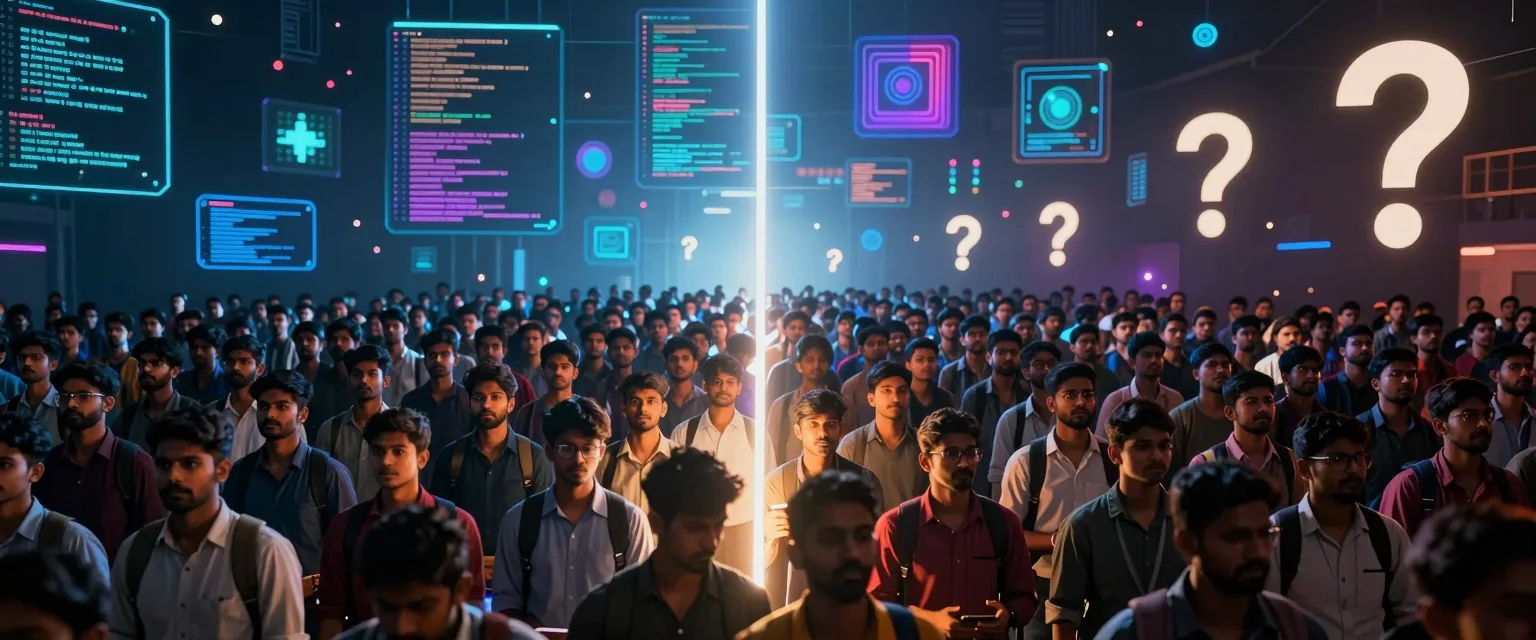
India's Population: Advantage or Time Bomb?
A billion working-age Indians: in the AI age, either a superpower or an economic disaster. Why the 2025-2027 window sets India's next 50 years.
For decades, India celebrated its demographic dividend:
"China is aging, India is young!"
"1.4 billion people = massive workforce!"
"We'll be the world's factory after China!"
The logic was simple: More working-age people = more economic growth.
But in 2026, that logic is breaking down.
Because AI doesn't care how many workers you have. It cares how many skilled workers you have.
And right now, India is racing against time to skill 600 million people before they become unemployable.
The clock is ticking. And we're losing.
The Numbers (2025-2026)
Let's start with the facts (demographic figures below are based on early-2026 estimates; check the latest Census and UNFPA data for updated numbers):
India's working-age population (15-59 years):
- 1.01 billion people - peaks around 2041
- 68% of total population (vs China's aging workforce)
- Median age: 28-29 (China: 39, Japan: 49, Germany: 48)
- 600 million in labor pool - IF they can find jobs
Sounds amazing, right?
Here's the problem:
School enrollment: DOWN 13.4 million by 2025 (as of early-2025 reporting; figure may have shifted further)
Youth unemployment in AI-exposed sectors: UP 3 percentage points (based on mid-2025 data; recent trends may differ)
Skill mismatch: 600M workers, but how many are Industry 4.0 ready?
India's demographic dividend window is closing. And AI is slamming it shut.
The Two Scenarios
India's population is either a superpower or a disaster. There's no middle ground.
🟢 Scenario 1: Population = Advantage
If India acts fast, here's the prize:
1. World's Factory (Post-China)
- Companies diversify from China (geopolitical risk)
- India becomes manufacturing hub (labor + English + democracy)
- Textiles, electronics, automotive, pharma
2. Global Services Hub (Already Happening)
- IT outsourcing ($250B industry)
- AI services (training, annotation, integration)
- Remote work for US/EU companies
3. Demographic Dividend Until 2041
- Young workforce = higher savings
- Higher savings = more investment
- More investment = economic growth
4. Internal Consumption Market
- 1.4 billion consumers
- Middle class growing
- Domestic demand drives growth
The model: China 1990-2020. Export-led growth + demographic dividend.
🔴 Scenario 2: Population = Disaster
If India fails, here's the nightmare:
1. Jobless Growth
- GDP grows but jobs don't (AI automation)
- 600M workers but no jobs for them
- Youth unemployment spikes
2. Demographic Disaster
- Large unskilled population = burden (not dividend)
- Social instability (unemployed youth = protests, crime)
- Political extremism rises
3. AI Wipes Out Entry-Level Jobs
- Junior developers = automated (AI coding)
- Data entry = automated
- Customer service = automated
- Manufacturing = robots
4. The Window Closes
- Demographic dividend peaks 2041
- After that, India ages too
- Fertility already declining (school enrollment down 13.4M)
The model: Failed industrialization. Large population = liability.
The Brutal Truth: India Is Headed Toward Scenario 2
Here's why:
1. Skill Mismatch at Massive Scale
600 million in labor pool. How many are AI-ready?
- Most education = rote learning (not critical thinking)
- Curriculum outdated (teaching for 1990s jobs)
- STEM graduates but poor practical skills
- IT sector can absorb maybe 10M. What about the other 590M?
2. The Jobs Being Created Require Skills India Doesn't Teach
AI economy needs:
- AI/ML engineers
- Cloud architects
- Cybersecurity specialists
- Data scientists
- AI ethicists
India's education produces:
- Generic engineers (millions)
- BBA/BCom graduates (more millions)
- Arts graduates (even more millions)
The gap is massive.
3. AI is Automating Exactly the Jobs India Relied On
India's growth model:
- IT outsourcing (coding, testing, support)
- BPO (call centers, data entry)
- Manufacturing (low-skill assembly)
AI's hit list:
- Coding = AI tools (GitHub Copilot, Cursor)
- Call centers = chatbots
- Data entry = automation
- Assembly = robots
The ladder India climbed is disappearing.
4. School Enrollment Declining = Window Closing
13.4 million fewer students by 2025.
Why? Fertility decline. India's TFR (Total Fertility Rate) (figures based on NFHS-5 and UN projections; the next NFHS round may revise these):
- 1970: 5.6 children per woman
- 2000: 3.2
- 2025: 2.0 (replacement level)
- Some states (Kerala, TN): 1.1-1.7
What this means:
- Demographic dividend window is narrower than expected
- Peak working-age population comes sooner
- After 2041, India ages rapidly
We don't have 50 years to figure this out. We have 15.
The North-South Divide (India's Secret Crisis)
Here's a problem nobody talks about:
India isn't one country demographically. It's two.
North India (UP, Bihar, MP, Rajasthan)
Profile (TFR figures from NFHS-5 and state-level estimates; these may have declined further by 2026):
- Young population (TFR 2.5-3.0)
- High birth rates
- Large under-14 population
- Drives national population growth
The problem:
- Poor education quality
- Low skill levels
- High unemployment
- Limited industry
Status: Young but unskilled
South India (Kerala, TN, Karnataka, AP, Telangana)
Profile:
- Aging population (TFR 1.1-1.7)
- Low birth rates
- Schools closing (80,000+ since 2019)
- Workforce shrinking
The strength:
- Better education
- Higher skill levels
- More industry (Bangalore, Hyderabad, Chennai)
Status: Skilled but aging
The Solution Should Be Obvious:
North's young workers → South's jobs
What's actually happening:
- "Sons of the soil" politics (locals vs migrants)
- Social tensions
- Language barriers
- Limited portable social security
Kerala example:
- TFR 1.1 (among lowest globally)
- Schools closing by the hundreds
- Elderly dependency rising
- Needs young workers but resists North Indian migration
The result: North has unemployed youth. South has unfilled jobs. They don't connect.
What Needs to Happen (And Won't)
To turn Scenario 2 into Scenario 1, India needs:
1. Education Revolution
- Industry 4.0 curriculum NOW
- Practical skills over rote learning
- AI/ML training in schools
- Vocational education expansion
Current status: Talking, not doing
2. Labor-Intensive Manufacturing
- Attract companies leaving China
- Infrastructure for factories (roads, power, water)
- Ease of doing business (faster approvals)
Current status: Progress slow, bureaucracy remains
3. Women in Workforce
- Female labor participation = 20-30% (as of 2025 PLFS data; recent surveys suggest modest improvement) (should be 60%+)
- Childcare support
- Safe work environments
- Social change
Current status: Cultural barriers remain strong
4. Internal Migration Freedom
- Portable social security
- No linguistic/regional barriers
- Housing for migrants
- Integration policies
Current status: "Sons of the soil" politics blocking
5. Upskilling at Scale
- Reskill 600M workers for AI economy
- Government + private sector partnership
- Free/cheap online training
- Incentives for companies to train
Current status: Small programs, not at scale
The Brutal Math
Let's do the calculation:
India needs to skill: 600 million workers
Time window: 15 years (until 2041)
Rate needed: 40 million per year
Current rate: Maybe 5-10 million per year (optimistic)
Gap: 30+ million per year shortfall
The math doesn't work.
Why India Will Probably Fail
I hate to be pessimistic, but here's the reality:
1. Political Will = Missing
- Short-term election cycles (5 years)
- Demographic dividend = long-term (15-20 years)
- Politicians focus on wins they can claim
- Education reform = invisible, slow, no photo ops
2. Bureaucracy = Gridlock
- Policy announced ≠ policy implemented
- 28 states + center = coordination nightmare
- Corruption, delays, inefficiency
3. Cultural Inertia
- Engineering degree = status (even if useless)
- Vocational training = looked down upon
- Women working = still controversial in many areas
- Migration = resisted
4. Private Sector = Focused on Top 10%
- TCS, Infosys, Wipro hire the best
- The other 590M? Nobody's problem
- Market failure: Companies won't train masses (no incentive)
5. AI Moving Faster Than Policy
- By the time government acts, jobs are automated
- Education reform takes 10+ years
- AI disruption happening NOW
Current trajectory: Scenario 2 (disaster)
What You Can Do (Individual Action)
Since the government won't save you, save yourself:
If You're a Student:
✅ Learn AI/ML NOW (free courses: Coursera, YouTube) ✅ Practical skills over degrees (portfolio > resume) ✅ English fluency (global remote work) ✅ Soft skills (communication, leadership) ❌ Don't rely on degree aloneIf You're a Working Professional:
✅ Upskill constantly (AI tools, cloud, new tech) ✅ Side income streams (don't rely on one job) ✅ Network globally (remote work opportunities) ✅ Teach yourself what your company won't ❌ Don't assume your job is safeIf You're a Parent:
✅ Tech education for kids (coding, AI basics) ✅ Critical thinking over rote learning ✅ Vocational skills (backup plan) ✅ English medium education ❌ Don't force engineering if they're not suitedIf You're an Employer:
✅ Train your workforce (it's cheaper than hiring) ✅ AI augmentation (not replacement) ✅ Hire for potential, train for skills ❌ Don't wait for government programsThe Comparison That Hurts
China (1980-2010):
- Large young population ✅
- Manufacturing-led growth ✅
- Export economy ✅
- Became global factory ✅
India (2020-2040):
- Large young population ✅
- Manufacturing-led growth ❓ (trying)
- Export economy ❓ (some sectors)
- Become global factory ❓ (AI complicates this)
The difference: China industrialized BEFORE AI. India is trying to industrialize DURING AI.
That changes everything.
The Timeline
2025-2027: Critical window
- AI adoption accelerating
- Jobs disappearing
- Education reform needed NOW
2027-2030: Tipping point
- If reforms happen → Scenario 1 possible
- If not → Scenario 2 locked in
2030-2041: Demographic dividend window
- Working-age population peaks
- Last chance to capitalize
2041+: India ages
- Demographic dividend ends
- Window closes permanently
After 2041, it doesn't matter if we fix education. The young population is gone.
Bottom Line
India's population is a loaded gun.
It could be a weapon (demographic dividend, economic superpower).
Or it could be pointed at our own head (demographic disaster, social instability).
Right now, we're headed toward disaster.
The skills gap is massive. AI is accelerating. The window is closing. And the government is moving too slow.
Individual action is the only answer.
Don't wait for policy. Don't wait for reform. Don't wait for your company.
Skill yourself. Or get left behind.
The demographic dividend India celebrated? It's turning into a demographic disaster.
Unless we act. Now.
Key Takeaways
⚠️ 600M workers, but how many are AI-ready? - Skill mismatch at scale
⚠️ Demographic window closing - Peaks 2041, then India ages
⚠️ School enrollment down 13.4M - Fertility declining faster than expected
⚠️ North-South divide - Young but unskilled vs skilled but aging
⚠️ AI automating India's growth model - IT, BPO, manufacturing at risk
⚠️ 15-year window - After 2041, it's too late
⚠️ Government moving too slow - Individual action = only hope
Do you think India can turn this around? Or are we headed for disaster? Share your thoughts in the comments below.
Related Reading:
Enjoying this article?
Get posts like this in your inbox. No spam, unsubscribe anytime.