CES 2026: Physical AI and the Robot Renaissance
CES 2026 highlights from NVIDIA's Jensen Huang keynote, Boston Dynamics' Atlas humanoid, and the explosion of AI-powered robotics. What developers need to know about embodied AI.
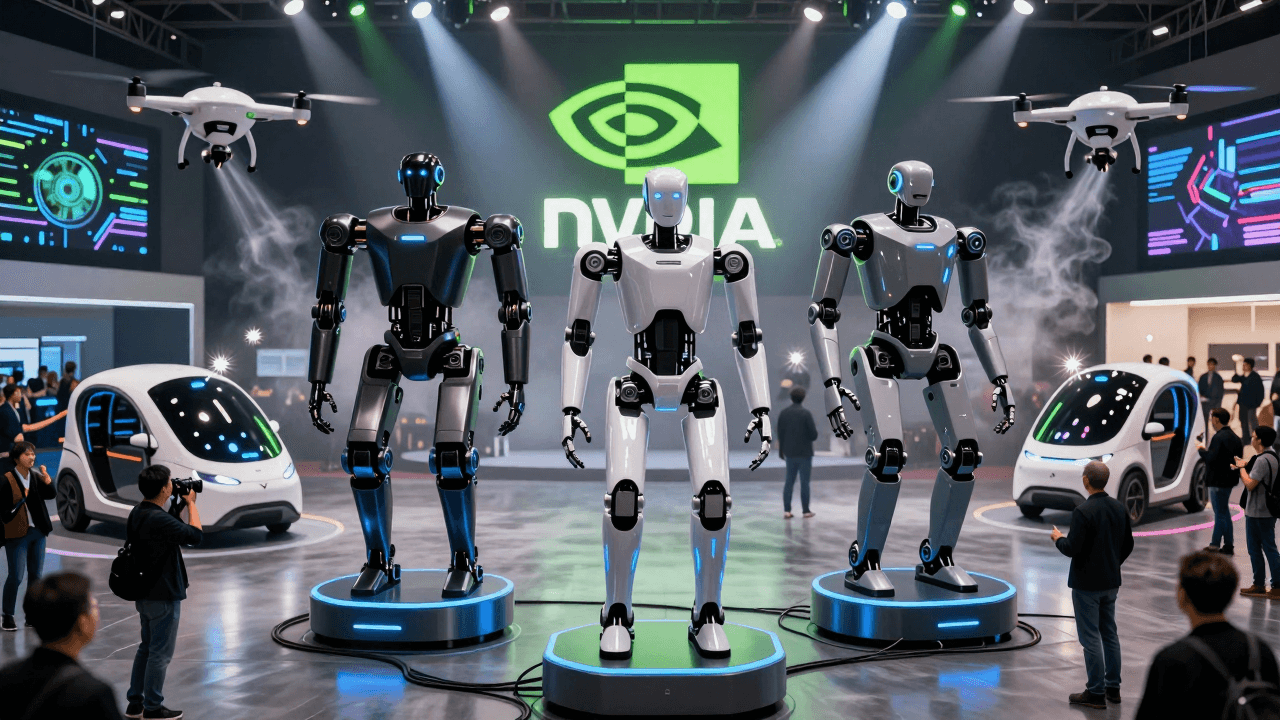
CES 2026 (January 6-9) marks a pivotal moment: the consumer electronics show has become an AI robotics showcase. NVIDIA's Jensen Huang keynote on January 5 set the tone with "physical AI" as the theme. Boston Dynamics (Hyundai) unveiled production-ready Atlas humanoids. Tesla's AI5 chip, announced separately, promises 40x faster AI processing than AI4. Record 3,600+ innovation award submissions signal an industry in overdrive. Here's what matters from the most robotics-focused CES ever.
NVIDIA's "Physical AI" Vision
Jensen Huang Keynote Highlights
Date: January 5, 2026 (pre-CES)
Theme: "Physical AI: Intelligence Meets the Real World"
Key announcements:
| Announcement | Details |
|---|---|
| Cosmos | World simulation platform for robotics |
| Isaac GR00T | Humanoid robot foundation model |
| Jetson Thor | Processor for humanoid robots |
| Project DIGITS | Personal AI supercomputer |
| Blackwell Ultra | Next-gen GPU architecture |
What is "Physical AI"?
NVIDIA's framing positions AI's next frontier as embodied intelligence:
| Era | Focus | Examples |
|---|---|---|
| 2010s | Cloud AI | Recommendations, search |
| 2020-2024 | Generative AI | ChatGPT, Midjourney |
| 2025+ | Physical AI | Robots, autonomous vehicles, industrial automation |
Cosmos World Simulation
Purpose: Train robots in simulated environments before real-world deployment
Capabilities:
- Physics-accurate simulation
- Synthetic data generation
- Multi-robot scenario training
- Transfer learning to physical robots
Why it matters: Training robots in the real world is slow, expensive, and dangerous. Simulation accelerates development 100-1000x.
The Humanoid Robot Explosion
Boston Dynamics Atlas (Hyundai)
The reveal: Production-ready Atlas humanoid robots, showcased by Boston Dynamics (a Hyundai subsidiary) in partnership with Google DeepMind
| Specification | Details |
|---|---|
| Height | 1.5m |
| Weight | 89 kg |
| Degrees of freedom | 28 |
| Speed | 5.4 km/h walking |
| Payload | 25 kg |
| Battery life | 2 hours active |
- Bipedal locomotion on uneven terrain
- Object manipulation with dexterous hands
- Fall recovery and self-righting
- Voice and gesture interaction
Target markets: Warehouse logistics, manufacturing, hazardous environments
Other Humanoid Announcements
| Company | Robot | Focus | Status |
|---|---|---|---|
| Tesla | Optimus Gen 3 | General purpose | Prototype, 2026 production target |
| Figure | Figure 02 | Warehouse work | Deployed at BMW |
| Agility | Digit | Logistics | Deployed at Amazon |
| Unitree | H1 | Research/consumer | Available now |
| 1X | NEO | Home assistance | Early production |
| Apptronik | Apollo | Industrial | Pilot deployments |
The $100 Billion Market
| Segment | 2026 Market | 2030 Projection |
|---|---|---|
| Industrial robots | $40B | $80B |
| Humanoid robots | $2B | $25B |
| Consumer robots | $15B | $30B |
| Service robots | $10B | $25B |
Automotive AI Dominance
Tesla AI5 Chip
Note: Tesla was not an exhibitor at CES 2026. AI5 details emerged from separate announcements by Elon Musk.
Claim: 40x faster AI processing speed than AI4
| Metric | AI4 (HW4) | AI5 |
|---|---|---|
| AI TOPS | 144 | ~2,000-2,500 (estimated) |
| Process | 7nm | Not confirmed |
| Power | 36W | 50W |
| Cameras supported | 8 | 12 |
- Full Self-Driving v13+
- Robotaxi operation
- Optimus robot brain
Autonomous Vehicle Announcements
| Company | Announcement | Timeline |
|---|---|---|
| Waymo | Expanded service areas | 2026 |
| Cruise | Resumed operations, new partnership | 2026 |
| Zoox | Robotaxi fleet expansion | 2026 |
| Aurora | Commercial trucking launch | 2026 |
| Mercedes | L3 deployment expansion | 2026 |
The Connected Car Evolution
| Feature | Current | CES 2026 |
|---|---|---|
| Voice assistant | Basic commands | Full LLM integration |
| ADAS | Driver assist | Supervised autonomy |
| Infotainment | Apps | AI-personalized experience |
| Maintenance | Alerts | Predictive, self-healing |
Edge AI and Smart Devices
The Shift to On-Device AI
| Trend | Driver |
|---|---|
| Privacy | Data stays on device |
| Latency | Instant response |
| Cost | No cloud API fees |
| Offline | Works without connectivity |
Key Hardware Announcements
| Company | Product | AI Focus |
|---|---|---|
| Qualcomm | Snapdragon 8 Elite 2 | 45 TOPS NPU |
| Apple | M5 (expected) | Enhanced Neural Engine |
| MediaTek | Dimensity 9400 | On-device LLM |
| Samsung | Exynos 2500 | 3nm AI processor |
| Intel | Lunar Lake+ | AI PC acceleration |
Smart Home AI
| Category | Evolution |
|---|---|
| Voice assistants | From keyword to conversation |
| Security | From recording to understanding |
| Energy | From scheduling to predicting |
| Appliances | From smart to autonomous |
Developer Opportunities
Robotics Development
Getting started with physical AI:
| Platform | Use Case | Complexity |
|---|---|---|
| NVIDIA Isaac | Industrial robotics | High |
| ROS 2 | General robotics | Medium-High |
| Arduino + AI | Simple projects | Low-Medium |
| Raspberry Pi + Coral | Edge AI prototypes | Low-Medium |
- Computer vision for embodied systems
- Reinforcement learning
- Sensor fusion
- Real-time systems programming
- ROS 2 development
Embedded AI Development
Key frameworks:
| Framework | Platform | Best For |
|---|---|---|
| TensorFlow Lite | Mobile, embedded | Broad compatibility |
| PyTorch Mobile | Mobile | Research transition |
| ONNX Runtime | Cross-platform | Model portability |
| Core ML | Apple | iOS/macOS |
| Qualcomm AI Engine | Snapdragon | Android flagship |
Career Paths in Physical AI
| Role | Demand | Salary Range (US) |
|---|---|---|
| Robotics ML Engineer | Very High | $180-300K |
| Perception Engineer | Very High | $160-280K |
| Embedded AI Developer | High | $140-220K |
| Simulation Engineer | High | $150-250K |
| Controls Engineer | Medium-High | $130-200K |
What This Means for the Industry
Short-Term (2026)
- Pilot deployments of humanoid robots in warehouses
- Expansion of robotaxi services
- Consumer products with meaningful on-device AI
- Developer tools maturing for physical AI
Medium-Term (2027-2028)
- Production scale humanoid manufacturing
- Home robots reaching consumer markets
- Autonomous delivery at scale
- AI in every device as standard expectation
Long-Term (2029+)
- General-purpose robots in homes and workplaces
- Full autonomy in transportation
- Robot-as-a-service business models
- Human-robot collaboration as norm
Concerns and Challenges
Technical Challenges
| Challenge | Status |
|---|---|
| Battery life | Major limitation (2-4 hours typical) |
| Dexterity | Improving but not human-level |
| Navigation | Good in controlled environments |
| Reliability | Not yet production-grade for many applications |
Economic Concerns
| Issue | Reality |
|---|---|
| Job displacement | Real, particularly in logistics and manufacturing |
| Cost | Humanoids still $50-100K+ per unit |
| ROI timeline | 3-5 years for most deployments |
| Maintenance | Infrastructure not yet mature |
Safety and Regulation
| Area | Status |
|---|---|
| Safety standards | Evolving (ISO, IEEE) |
| Liability | Unclear in many jurisdictions |
| Insurance | Limited availability |
| Public acceptance | Mixed |
CES 2026 Predictions That Emerged
What We'll See by CES 2027
Based on this year's announcements:
- First commercial humanoid deployments at scale
- Robotaxi expansion to 20+ US cities
- On-device LLMs in flagship smartphones
- Consumer robots under $5,000
- AI PCs as default configuration
Investment Implications
| Sector | Outlook |
|---|---|
| Semiconductor | Continued growth (NVIDIA, AMD, Qualcomm) |
| Robotics | High growth, high risk |
| Automotive | Transition phase |
| Consumer electronics | AI differentiation critical |
How to Stay Current
Follow These Companies
| Company | Why |
|---|---|
| NVIDIA | Platform leader for physical AI |
| Boston Dynamics | Humanoid robotics leader |
| Tesla | Robotaxi and Optimus development |
| Figure | Fast-moving humanoid startup |
| Waymo | Autonomous vehicle leader |
Key Conferences Post-CES
| Conference | Date | Focus |
|---|---|---|
| GTC (NVIDIA) | March 2026 | AI infrastructure and robotics |
| ICRA | May 2026 | Robotics research |
| Computex | June 2026 | Computing hardware |
| ROSCon | October 2026 | ROS ecosystem |
Learning Resources
| Resource | Type |
|---|---|
| NVIDIA Deep Learning Institute | Courses |
| ROS 2 Documentation | Technical |
| Coursera Robotics Specialization | Academic |
| Papers With Code (Robotics) | Research |
Conclusion
CES 2026 marks the moment when "AI" and "robotics" fully converged. NVIDIA's "physical AI" framing captures the shift: the next decade of AI progress will be measured not in benchmark scores but in real-world capability—robots that walk, cars that drive, devices that understand.
For developers, this creates unprecedented opportunity. The skills for building physical AI systems—computer vision, reinforcement learning, embedded systems, simulation—are in extreme demand. The tools are maturing. The market is arriving.
For the broader industry, the implications are profound. The robots showcased at CES 2026 aren't science fiction prototypes; they're production-intent machines. The timeline from demo to deployment is collapsing.
The robot renaissance isn't coming. As CES 2026 made clear, it's here.
Sources:
- Yahoo Finance (CES 2026 Preview)
- Arm Newsroom (CES Trends)
- Engadget (NVIDIA Keynote Coverage)
- Company announcements and press releases
Enjoying this article?
Get posts like this in your inbox. No spam, unsubscribe anytime.