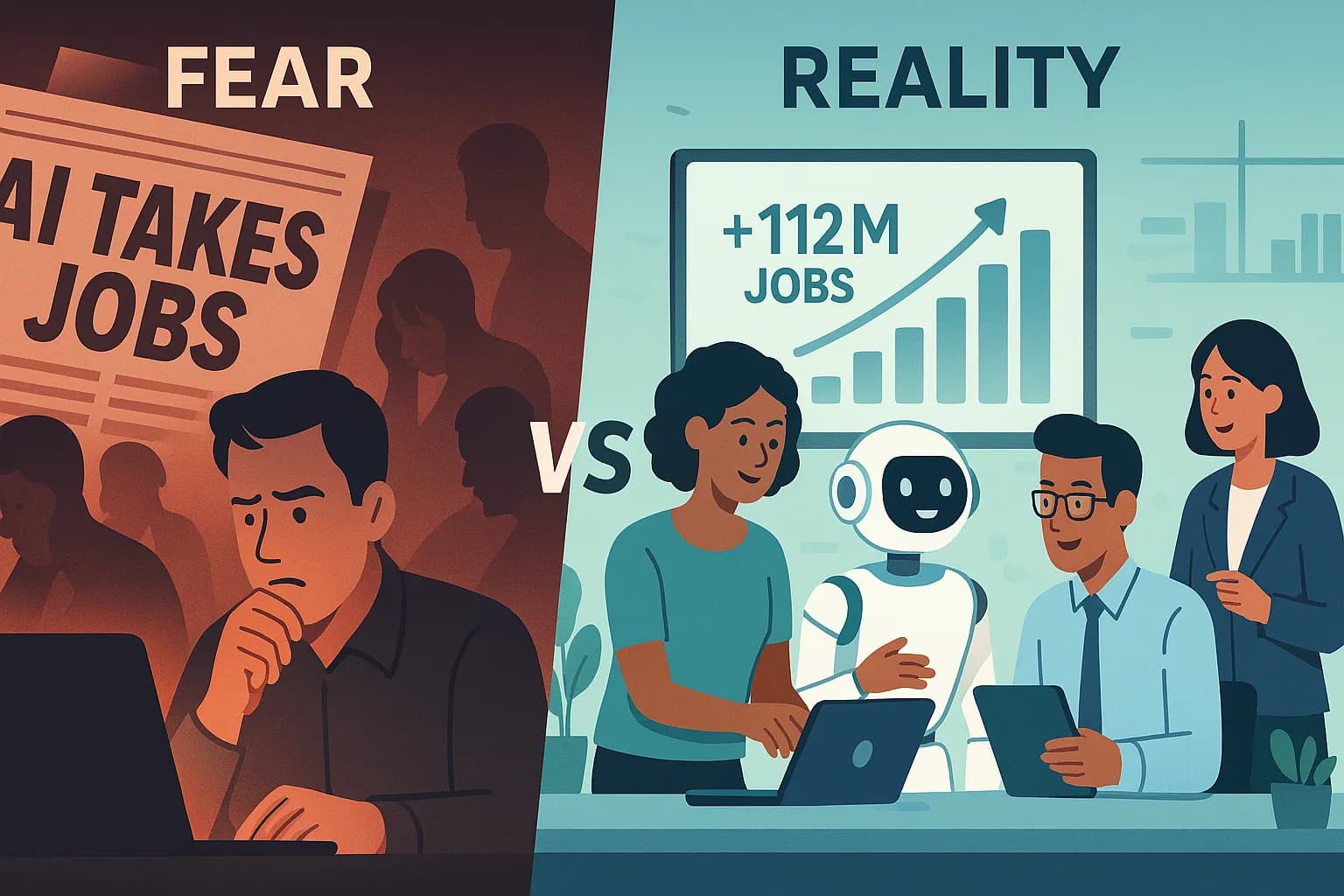
AI Job Apocalypse? The Data Says Otherwise
Everyone's freaking out about AI taking jobs. Here's what's really happening according to WEF, Goldman Sachs, and 2025-2026 employment data.
If you've been on LinkedIn or Twitter lately, you've probably seen the panic:
"AI will take 300 million jobs!"
"ChatGPT replaced our entire content team!"
"Learn to code or become unemployed!"
The fear is real. But is it justified?
I dug into the actual data from the World Economic Forum, Goldman Sachs, and recent employment reports. Here's what's actually happening in 2025-2026.
The Numbers Everyone's Ignoring
Global job market (2025-2026) (figures from WEF Future of Jobs Report and Goldman Sachs research; the February 2026 SaaSpocalypse and subsequent market shifts may have altered some of these projections):
- 85 million jobs will be displaced by AI automation
- 97 million new jobs will be created
- Net result: +12 million jobs
Yes, you read that right. More jobs created than lost.
United States (2024-2025 data) (pre-SaaSpocalypse figures; post-selloff hiring and layoff dynamics may differ):
- AI caused 12,700 job losses (0.1% of all layoffs)
- AI created 119,900 direct jobs
- That's 10x more jobs created than lost
Goldman Sachs projection (issued before the February 2026 market correction):
- 6-7% of US workforce displaced (temporary)
- +15% productivity boost
- 0.5% unemployment bump (short-term)
"But My Job is at Risk!"
Maybe. Here's who's actually vulnerable:
High-Risk Jobs (AI Can Do These)
- Entry-level programmers (code generation)
- Customer service reps (chatbots)
- Data entry clerks (automation)
- Basic content writers (AI writing tools)
- Telemarketing (voice AI)
Low-Risk Jobs (AI Can't Replace These)
- Managers and team leads (human judgment)
- Sales professionals (relationship building)
- Skilled tradespeople (plumbers, electricians)
- Healthcare providers (empathy + physical work)
- Creative directors (strategy + vision)
The pattern: Routine tasks get automated. Complex, creative, or human-centric work becomes more valuable.
The Paradox: More AI = More Jobs
History keeps proving this:
ATMs (1970s):
- Prediction: Bank tellers will disappear
- Reality: More branches opened, tellers shifted to sales roles
Email (1990s):
- Prediction: Postal workers done
- Reality: E-commerce exploded, delivery jobs boomed
Tractors (1920s):
- Prediction: Farming jobs killed
- Reality: Cheaper food → larger population → more jobs overall
AI (2020s):
- Prediction: Everyone's unemployed
- Reality: Jobs reshape, don't disappear
Why AI Creates Jobs (The Part Media Won't Tell You)
1. AI needs humans
- Data labelers (teaching AI)
- AI trainers (fine-tuning models)
- Prompt engineers (getting AI to work)
- AI ethicists (keeping it safe)
2. Productivity boost = growth
- +15% productivity = more output
- More output = more customers
- More customers = need more workers
Example: AI writes the first draft, humans edit/refine. Same output, half the time. Company can now serve 2x customers with same team.
3. New industries emerge
- AI infrastructure (data centers, chips)
- AI security (protecting models)
- AI integration (consultants, implementers)
- AI content (trainers, curriculum)
The Real Divide (Here's What Matters)
The question isn't "Will AI take jobs?"
It's: "Which countries adapt fast enough?"
Winners (Heavy AI Investment)
- United States - Silicon Valley, heavy capex
- China - 70% of global AI patents
- Singapore - Infrastructure ready
- South Korea - Tech-first economy
These countries see: Productivity gains > Job losses
Losers (Unprepared)
- Developing Asia-Pacific - 55% of world population
- Infrastructure gaps - No computing power, skills
- Women hit hardest - 2x more exposed to automation
- Rural workers - 40% less likely to own smartphones
India's position: Mixed. Strong IT sector = opportunity. Weak rural infrastructure = risk.
What Should YOU Do?
If You're in Tech:
✅ Learn AI tools (don't fight them) — start with prompt engineering ✅ Shift from coding → problem-solving ✅ Management, architecture, strategy = safer ❌ Don't compete with AI on routine tasksIf You're a Student:
✅ Focus on: AI/ML, cloud, cybersecurity ✅ Soft skills: Leadership, communication, creativity ✅ Hybrid roles (tech + business/design/domain) ❌ Avoid: Pure data entry, basic coding, repetitive workIf You're an Employee:
✅ Upskill NOW (company-paid courses) ✅ Automate your boring tasks (make yourself more valuable) ✅ Learn your company's AI tools before they mandate it ❌ Don't ignore AI hoping it goes awayIf You're a Manager:
✅ Train your team on AI augmentation ✅ Focus on outcomes, not hours worked ✅ Restructure: fewer juniors, more AI-augmented seniors ❌ Don't cut jobs just because you canThe Timeline (What to Expect)
2025-2026: Transition period
- Early adopters gain productivity edge
- Some routine jobs lost (mainly junior roles)
- New AI job titles emerge
- Wage pressure on low-skill roles
2027-2030: Reshaping phase
- AI-native workflows become standard
- Education systems catch up (slowly)
- Countries diverge (winners vs losers clear)
- Net job growth continues
2030+: New normal
- AI is like Excel or email (everyone uses it)
- Jobs we can't imagine today exist
- Routine work = fully automated
- Human work = strategy, creativity, relationships
Bottom Line
The apocalypse isn't coming.
Jobs aren't disappearing—they're changing. Fast.
The real question: Are you changing fast enough?
85 million jobs lost, 97 million created. That's not a disaster. That's a reshaping.
The winners will be those who adapt. The losers will be those who wait.
Which one are you?
Key Takeaways
✅ Net +12M jobs globally (2025-2026)
✅ Routine tasks automated, complex work valued
✅ AI creates more jobs than it kills (historically proven)
✅ Country-level adaptation matters more than individual panic
✅ Upskill NOW - waiting = falling behind
What's your biggest fear about AI and jobs? Share in the comments below.
This post is based on data from World Economic Forum (2025), Goldman Sachs Research, UNDP Asia-Pacific reports, and recent employment statistics. All projections subject to change as AI evolves. Note: the February 2026 SaaSpocalypse selloff and its aftermath may have shifted some of the employment projections cited above.
Related Reading:
Enjoying this article?
Get posts like this in your inbox. No spam, unsubscribe anytime.