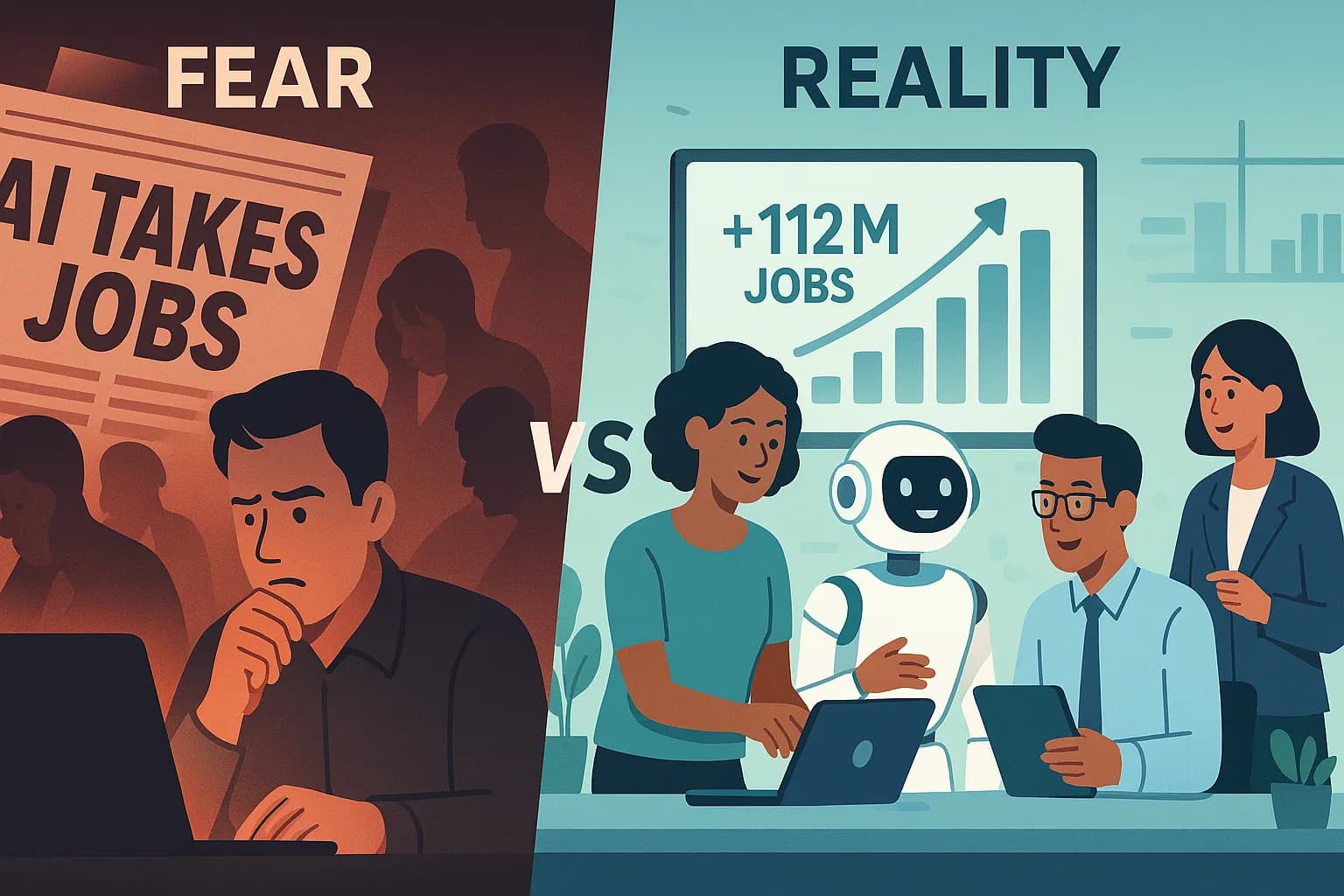
The 'AI Is Just a Fad' Mindset Is a Career Mistake in 2026
Many developers treat AI as temporary hype and wait for it to 'stabilize.' Why that mindset costs careers, with examples from India's IT industry.
Note: Statistics, spending figures, and adoption rates in this article reflect data available as of January 2026. Verify for latest figures.
"AI is like blockchain---lots of noise, then it fades. I'll learn it when it stabilizes."
I hear this from developers every week. In Slack channels, on LinkedIn, during chai breaks at tech parks across Bangalore and Hyderabad. It is a comfortable position, and I understand why it feels safe. After all, we have seen technology hypes come and go. The metaverse was supposed to revolutionize everything by now. NFTs were the future of digital ownership. Web3 was going to decentralize the internet.
So when AI exploded onto the scene with ChatGPT in late 2022, followed by an avalanche of models, tools, and breathless predictions, the skepticism made sense. New models drop weekly. Today's breakthrough becomes tomorrow's obsolete technique. Enterprise AI projects have a roughly 50% failure rate, with most never graduating beyond pilot stage. Why invest hundreds of hours learning something that might look completely different in six months?
Here is the uncomfortable truth: waiting for "stability" in AI is like waiting for the internet to "stabilize" in 1997. The technology will keep evolving. But those who experiment now---messy, imperfect experiments---are building compound advantages that late adopters will never catch up on.
The developers treating AI as optional are not being prudent. They are making the biggest career mistake of 2026.
And nowhere is this clearer than in India's massive IT services industry, where an entire ecosystem's "wait-and-see" approach is turning into a cautionary tale in real-time.
This article is not another AI hype piece. It is an evidence-based, empathetic but firm examination of why the sideline strategy fails---backed by real data from 2026, psychological insights, historical parallels, and concrete steps you can take starting today. Whether you are a mid-level developer in Pune, a fresh graduate in Chennai, or a team lead in Noida, this concerns your career trajectory for the next decade.
Let us unpack why waiting is not neutral---it is falling behind.
The Psychology of the 'Wait for Stability' Mindset
Before we examine evidence, let us acknowledge something important: the instinct to wait is not irrational. It is rooted in legitimate concerns.
Why Smart People Choose to Wait
Fear of wasted investment. You have limited time. Between your job, family, and that fitness goal you keep postponing, carving out hours to learn AI feels like a gamble. What if the framework you learn becomes obsolete? What if the company you target pivots away from that technology stack?
Past fad trauma. Remember when your manager insisted everyone learn blockchain for the "inevitable enterprise adoption"? Or when that friend quit their job to build a metaverse startup that no longer exists? The tech industry has a pattern of overpromising and underdelivering. It is reasonable to be cautious.
The changing models problem. GPT-3, GPT-4, GPT-4o, GPT-5. Claude 2, Claude 3, Claude 3.5, Opus 4.7. Gemini Pro, Ultra, 2.0. Every few months, the "best" model changes. Learning prompt engineering for one model feels like learning for a platform that might be replaced. Why not wait until things settle?
Enterprise skepticism. You have seen enterprise AI projects at your company. The chatbot that was supposed to handle customer queries but needed constant babysitting. The "intelligent" document processor that required more human review than the manual process. If big companies with deep pockets struggle, why should you rush?
These are valid observations. But they miss a crucial pattern that history has shown us repeatedly.
The Historical Pattern You Cannot Ignore
The Internet (1990s): Major retailers like Sears and Kmart waited for the web to "prove itself." By the time they took it seriously, Amazon had built a decade-long advantage. Early experimenters---even with clunky websites---developed organizational knowledge that late movers could not replicate.
Cloud Computing (2008-2015): When AWS launched, enterprise IT scoffed: "We cannot trust our data to someone else's servers." Companies that waited for cloud to "mature" paid premium prices to migrate legacy systems years later.
Mobile Revolution (2007-2012): Developers dismissed mobile as a "consumer toy" with no enterprise relevance. Those who ignored iOS and Android early found themselves scrambling, competing with engineers who had years of mobile-native intuition.
In each case, early technology was genuinely immature. But developers who engaged early developed intuition that cannot be fast-tracked.
The 2026 Reality: This Is Not a Drill
The pattern with AI is not repeating---it is accelerating.
| Metric | 2024 | 2025 | 2026 (Current) |
|---|---|---|---|
| Global enterprise AI spending | $150B | $220B | $340B+ (projected) |
| India AI adoption rate (BCG) | 78% | 87% | 92% (BCG projection for 2026) |
| AI-related job postings (India) | +45% YoY | +62% YoY | +78% YoY |
| Developers using AI tools daily | 35% | 55% | 72% |
Waiting is not neutral. In a market moving this fast, standing still means falling behind.
What Developers Lose by Sitting Out
The cost of waiting is not just theoretical. It compounds across three dimensions that will define your career trajectory.
1. Missed Learning Opportunities: The Intuition Gap
AI is not just a new tool---it is a new paradigm. Working with large language models, understanding prompt engineering, building agentic systems, handling multimodal inputs---these require a different way of thinking about software.
Consider what early AI adopters have developed:
- Intuition for failure modes: They know when an LLM will hallucinate, when retrieval augmentation helps, when fine-tuning is overkill. This intuition comes from hundreds of experiments, not documentation.
- Architectural patterns: How to structure applications around non-deterministic outputs. How to build feedback loops. How to handle context windows. These patterns emerged from practitioners, not textbooks.
- Evaluation skills: Knowing how to assess whether an AI system is actually working---beyond surface-level "it sounds right"---is a learned skill that takes time to develop.
The developers who started experimenting in 2023-2024 have a two to three year head start on this intuition. They have made mistakes you have not made yet. They have developed pattern recognition you have not developed yet.
You cannot speed-run intuition. No amount of crash courses will replicate the deep understanding that comes from building, failing, debugging, and rebuilding. Every month you wait, the intuition gap widens.
2. Career Risks: The Market Is Already Shifting
The job market data is unambiguous:
| Role Category | Demand Trend (2026) | Salary Trend |
|---|---|---|
| AI/ML Engineers | +78% YoY | +35-45% premium |
| Prompt Engineers | +120% YoY | +25-40% premium |
| AI-augmented Developers | +45% YoY | +15-25% premium |
| Traditional Backend (no AI) | -15% YoY | Flat to declining |
| Manual QA/Testing | -40% YoY | Declining |
The uncomfortable reality: Your competition is not just other developers. It is developers augmented by AI tools. A single engineer using GitHub Copilot, Claude, and AI-assisted debugging can produce what used to require a team. If you are not one of those augmented engineers, you are competing at a structural disadvantage.
3. Bigger Picture Blindness: Implementers vs. Innovators
Perhaps the most insidious cost is what you do not see.
AI is not just changing how we write code---it is reshaping products, business models, ethics, and the nature of software itself. Developers who engage with AI understand:
- How AI changes what products are possible
- What new ethical considerations arise
- How to evaluate AI vendors and tools critically
- Where human judgment remains essential
- How to lead AI-driven projects, not just participate in them
Passive developers become replaceable implementers. They are told what to build and how to build it. Active developers become innovators. They shape what gets built and why.
A Tale of Two Developers
Developer A started tinkering with GPT-3 API in late 2022. Built projects that failed. Learned prompt engineering through trial and error. By 2024, became the go-to person for AI integration questions. In 2026, commands a 40% salary premium.
Developer B had the same skills in 2022. Decided to wait for AI to "stabilize." In 2025, completed certification but had no practical experience. In 2026, competing for entry-level AI positions against developers with three years of hands-on experience.
Developer B is not less capable. They made a strategic choice that compounded negatively. Which trajectory are you on?
The Indian IT Cautionary Tale: Reactive, Not Revolutionary
No ecosystem illustrates the cost of the "wait and see" mindset better than India's $250+ billion IT services industry. What is happening there is a masterclass in how reactive thinking creates long-term vulnerability.
The Narrative Arc
2023-2024: Panic. Headlines screamed that AI would "kill" Indian IT services. Analysts predicted mass unemployment. The industry that had built prosperity for millions seemed under existential threat.
2025: Cautious optimism. Major deals resumed. Companies reported AI revenue growth. Foreign institutional investors returned, betting on AI transformation potential. The existential crisis narrative faded.
2026: Reality check. The truth is more nuanced---and more concerning for individual developers than the headlines suggest.
The Good News
Indian IT services have shown resilience:
| Metric | Status (2026) |
|---|---|
| TCS AI revenue | $1.8B annualized |
| Infosys GenAI deal pipeline | +75% YoY |
| Wipro AI360 investment | $1B committed |
| Major deal wins | Record $50B+ TCV |
The Troubling Reality
But look beneath the surface:
The mindset remains reactive. Most Indian IT services firms invest heavily in AI only when clients fund specific ROI-proven projects. Innovation happens downstream of client demand, not upstream of it.
As Wipro CEO Srini Pallia noted about the transition from 2025 to 2026: the industry is shifting from proofs-of-concept to deployment---but driven by client demand, not internal vision. Clients decide when and how AI gets used. Indian IT firms execute.
The talent crisis is severe. For every qualified GenAI engineer, there are 10 open positions. Only 15-20% of the existing workforce is AI-ready by current assessments. Companies are scrambling to reskill, but the gap is widening faster than training programs can close it.
The growth paradox. Despite record deal sizes, Indian IT added just 17 net employees in 9 months. Revenue per employee is rising, but total headcount is flat or declining. The companies are more productive---but they need fewer people to achieve that productivity.
"AI Plumbers" vs. AI Innovators
Here is the most damaging pattern: Indian IT services are largely becoming "AI plumbers" rather than AI innovators.
What does this mean?
- They help clients integrate AI into existing systems (plumbing)
- They maintain and optimize AI solutions built elsewhere (plumbing)
- They manage the infrastructure that runs AI workloads (plumbing)
What they are not doing:
- Building foundational AI products
- Creating novel AI applications for global markets
- Leading AI research and development
- Setting the AI agenda rather than responding to it
There is nothing wrong with plumbing. The world needs plumbers. But plumbers get paid less than architects. And when better automated plumbing tools emerge, plumbers are the first to be displaced.
The Individual Developer's Dilemma
If you work at an Indian IT services firm:
Best case: Your company wins an AI project, allocates you to it, and you learn on the job---after the client has funded it, after someone else has taken the early risks.
Typical case: You remain on maintenance projects while hearing about AI initiatives in town halls. Reskilling opportunities may or may not materialize.
Worst case: Your role gets optimized away, and you compete for shrinking traditional positions while lacking AI experience.
The systemic problem: When your organization is reactive, your learning is reactive. You engage with AI after it is proven, not while it is being proven. By definition, you are always behind.
Global clients may increasingly bypass Indian IT for proactively innovating providers. When firms compete on cost rather than capability, employees bear the pressure.
The Path Not Taken
Contrast this with what proactive engagement looks like:
- Developers building AI side projects unprompted
- Teams experimenting with internal AI tools before clients request them
- Companies creating AI products for the market rather than just services for clients
- Engineers developing AI expertise in anticipation of demand, not in response to it
This proactive path creates premium positioning. It commands higher rates. It attracts better projects. It builds defensible expertise.
The Indian IT industry---institutionally---has largely chosen the reactive path. Individual developers do not have to make the same choice.
Proactive vs. Reactive AI Mindset: A Comparison
| Dimension | Reactive Mindset | Proactive Mindset |
|---|---|---|
| Learning Trigger | Wait for employer/client to fund training | Self-directed learning before demand |
| Experimentation | "I'll learn when I get assigned an AI project" | "I'm building AI projects to learn" |
| Risk Tolerance | Avoid investing time until ROI is proven | Accept early experiments may fail |
| Learning Speed | Slow---dependent on external opportunities | Fast---continuous self-directed growth |
| Knowledge Type | Procedural (how to use specific tools) | Intuitive (how to think about AI problems) |
| Career Trajectory | Compete for AI roles with no experience | Enter AI roles with demonstrated experience |
| Salary Outcome | Market rate at best | 20-40% premium for early expertise |
| Indian IT Example | Wait for client-funded PoC, then train | Build internal tools, contribute to open source |
| 5-Year Position | Playing catch-up | Setting the pace |
Why Now Is the Time to Dive In
If I have convinced you that waiting is costly, the next question is practical: how do you start when the landscape seems overwhelming?
The good news: barriers to AI experimentation have never been lower.
The Access Revolution
| Resource | Cost | What You Get |
|---|---|---|
| Claude Free Tier | $0 | Full access to capable LLM |
| Grok 3 Free | $0 | X's latest model, no paywall |
| Google Gemini | $0 | Multimodal capabilities |
| Hugging Face Models | $0 | Thousands of open-source models |
| Google Colab | $0 | GPU-enabled notebooks |
| LangChain/LlamaIndex | $0 | Agent-building frameworks |
The Learning Path That Works
| Timeline | Focus | Goal |
|---|---|---|
| Week 1-2 | Daily AI tool use, prompt engineering | Build intuition for capabilities/limitations |
| Week 3-4 | Foundational course (DeepLearning.AI, fast.ai) | Evaluate hype vs. substance |
| Month 2-3 | Build small project using AI APIs, document publicly | Demonstrate practical experience |
| Month 4-6 | Specialize (agents, RAG, fine-tuning), contribute to open-source | Develop genuine expertise |
Practical Starting Points
| Time Available | Actions |
|---|---|
| 30 min/day | Use AI for real work tasks, learn prompt engineering, join one AI community |
| 1-2 hrs/day | Complete DeepLearning.AI courses, build workflow automation, document publicly |
| Weekends | Build portfolio projects, participate in Kaggle, contribute to open-source |
The Mindset Shift
| Stop Thinking | Start Thinking |
|---|---|
| "I'll learn AI when it stabilizes" | "I'll build intuition through continuous experimentation" |
| "My employer will train me when it's time" | "My career is my responsibility" |
| "I might learn the wrong framework" | "Meta-skills transfer across any framework" |
FAQ: Addressing Common Concerns
Is AI really not a fad? How is it different from blockchain or metaverse hype?
Some AI applications are overhyped and will fail. But unlike blockchain (which solved problems most people did not have) or the metaverse (which required behavior changes people did not want), AI augments existing behaviors. People already search, write, code, analyze data---AI makes these faster.
The investment scale is unprecedented: hundreds of billions in infrastructure, largest tech companies reorganizing around AI, measurable productivity gains. Learning AI is not betting on one company---it is becoming fluent in a new computing paradigm.
How is Indian IT really doing with AI? Is the industry transformation real?
The nuanced reality: Indian IT services have survived the AI transition better than 2023 headlines predicted. Revenue is growing. Major deals are flowing. Companies like TCS are generating significant AI revenue.
The concern: Growth is largely reactive, not revolutionary. Firms execute client-demanded AI projects rather than creating AI products. The talent gap is severe (1 qualified engineer per 10 GenAI jobs). Net employment is essentially flat despite revenue growth.
For individual developers: Company success does not automatically translate to individual opportunity. You need AI skills regardless of whether your company is investing in them. Proactive self-development is essential because institutional reskilling is slower than market demand.
What if I start learning and models change?
The pace of change is a reason to start now, not wait. Foundational concepts transfer. Prompt engineering principles work across models. Understanding how LLMs fail helps you evaluate any model. Experience with RAG applies regardless of which embedding model you use.
What changes: Specific APIs, model names, hyperparameters. What stays stable: Problem decomposition, evaluation methodologies, integration patterns. Early adopters adapt their conceptual foundation to new implementations---much faster than learning from scratch.
What are simple ways for Indian developers to begin?
Today: Create free accounts on Claude, Gemini, and Grok. Use them 30 minutes daily on real work tasks.
First week: Build a simple AI-assisted tool (code review helper, documentation generator, test case suggester).
First month: Complete one project you can show others (GitHub, blog post, demo).
India-specific resources: NASSCOM FutureSkills, IIT/IIM courses on NPTEL, AI meetups in Bangalore/Hyderabad/Pune/Chennai.
The key is starting imperfect. Your first AI project will not be impressive. It does not need to be. Iteration improves quality. Waiting produces nothing.
Conclusion: Stop Waiting, Start Building
The "AI is a fad" mindset fails the historical test. Every major technological shift had skeptics who waited for stability. Those who waited paid premiums to catch up---or never caught up at all.
Waiting is not neutral. The intuition gap, career positioning gap, and opportunity gap widen every month you do not engage.
Indian IT illustrates institutional caution's costs. The industry is largely reactive on AI. Individual developers who adopt the same mindset inherit the same limitations.
The barriers have collapsed. Free tiers, open-source models, accessible frameworks---the constraint is not resources. It is willingness to begin.
Here is my challenge to you---in the next 24 hours:
- Open Claude, Gemini, or Grok
- Ask it to help with one real task you would otherwise do manually
- Notice what works and what fails
- Document that observation
Fifteen minutes. No course enrollment. Just one small experiment. Then do it again tomorrow.
Compound those experiments over six months, and you will have more practical AI experience than 80% of developers still "waiting for stability."
The revolution is not coming. It is here. Indian developers have immense potential---the technical talent, work ethic, problem-solving capability. What is needed is a shift from service mindset to builder mindset. From reactive to proactive.
Stop waiting for your employer to fund your AI education. Stop waiting for AI to stabilize. Start building today.
The AI revolution will not pause while you make up your mind. The question is whether you will be shaping it or shaped by it.
Sources and References:
- BCG India AI Adoption Report (2026)
- NASSCOM Industry Data Reports
- TCS, Infosys, Wipro Quarterly Earnings (FY2025-26)
- LinkedIn Workforce Analytics (India IT Sector)
- Gartner Enterprise AI Spending Projections
- Economic Times Tech Industry Coverage
Related Reading:
Enjoying this article?
Get posts like this in your inbox. No spam, unsubscribe anytime.